Showing posts with label Royal Fleet Auxiliary. Show all posts

01 May 2023

Owning the Littorals - My Planning Assumptions

 Owning the Littorals

My Planning Assumptions


Owning the Littorals is a series by BMR on the merits and capabilities of amphibious forces and what I believe their future should be. View the full series here and part two here.


            I love a good fantasy force, you probably love a good fantasy force too, everybody loves a good fantasy force. This includes many people in Main Building, I'm assuming. In this article, I'm going to outline some of the assumptions I've made in planning my own fantasy force, based on the Future Commando Force's own assumptions (assumptions always have to be made). I've tried to consider as many political, social, and strategic consequences as I can think of; however some have probably slipped through the gaps - so feel free to discuss over on Twitter.


Assumption One - The Army

            The first assumption I've made is that all Army supports to the Commando Brigade will remain at the same or similar levels - both of manning and equipment (although I will very much be making allowances for upgrading some equipment available to the Littoral Strike Groups). This is justified, in an army increasingly stretched for manpower, by the fact that the LSGs will act as a 'plug and play' out of area HQ unit - so army operations will be directly supported by their own supports.

            Number-crunching wise, I'm going of the assumption that the Commando Logistic Regiment has about 200 Commando-trained Army personnel under it's command (further breaking down, I'm going off a 50/50 RLC/REME split), 24 Commando, RE has approximately 492 Gunners under it's command and 29 Commando, RA has 430 Army personnel under it's command (my assumptions are 390 RA, 20 REME and 20 RLC. 33 Engineer Regiment (EOD) has either one or two Commando EOD troops (sources contradict each other here) under it's command - approximately 50 personnel, all trades.

            The final and biggest assumption on the part of the Army is that the North/South split is going to be embraced across Defence - primarily in the Army. This probably deserves it's own stand alone article but in brief 11 Brigade would be lose the Security Force Assistance role (with no replacement) and 11 and 4 Brigades would support the North/South split. These would use forward deployed troops (Cyprus in the North and Brunei, Oman in the South) to provide acclimatised presence wherever needed. These could also be deployed at sea with the LSGs to provide a larger force if needed - similar to the Australian approach.


Assumption Two - The Navy

            For amphibious operations, amphibious shipping is a prerequisite (unless we're invading the Isle of Wight). Currently, this is the two Albion class (although one is in extended readiness), three Bay class and RFA Argus. The longer term plan is that all six of these are to be replaced by a singular 'Multi-Role Support Ship'. Also planned to be in service by the middle of next decade (although in early design stages), is (up to) five Type 32 frigates.

            Completely unrelated, is the procurement of four Logistics Support Vessels to support the new ARCIMS unmanned Mine Counter Measure vessels. Without going into too much detail, I would reduce the number of (Royal Navy crewed) MRSS to four and use the savings to buy four much larger, much more useful Logistics Support Vessels (which would have use in amphibious landings). 


Assumption Three - The Air Force

            The RAF Regiment provides an unknown (to me) number of Tactical Air Control Parties, which would presumably remain the same. But because I need to bulk out this section more than a line and a half, I'm going to include Joint Helicopter Command here as well.

            I'm making several rather bold assumptions; the boldest being that the Treasury will allow the Fleet Air Arm to buy a tilt-rotor aircraft (presumably not Osprey). They have a price tag (and quite a big one at that) but a tilt-rotor aircraft would give the Queen Elizabeth class the ability to operate fixed wing AWACS and COD capabilities - freeing up most of the Merlin Mk.2 for ASW and the Mk.4 for Commando operations. Yes, it would be expensive, but more expensive than a £3 billion Aircraft Carrier and 900 Sailors? This means 16 Merlins would be available to the LSGs, along with four Commando Wildcats and around 14 Naval Wildcats.

            I'm also going to take forward basing to the extreme, a little bit, and assume that the Army can forward base a not insignificant aviation element East of Suez (Brunei would make sense, working from the already existing AAC airfields). This would aid in both Commando and Army operations. A notional Army contribution to the CHF would consist of 12 Apache and 12 Chinook Attack and heavy lift helicopters.


Assumption Four - Terminology and TLAs

            All the literature available online about the Future Commando Force (or FCF) is filled with absolute mountains of TLAs and TLA(B)s. From what I can work out the standard building block is due to be the Littoral Response Group (LRG), North or South (LRG[N] or LRG[S]). Each is made up of one Littoral Strike Unit (LSU) made up from a Commando Strike Company (CSC) from 40 or 45 Commando, along with supporting elements from across the rest of the Commando Brigade and is supported by a naval force made up of either HMS Albion or RFA Argus (in the North or South, respectively), a Bay class LSD, at least one surface escort and a logistics vessel(s).

            When both LRGs combine for larger operations, they form a Littoral Strike Group (LSG) and when this is complemented by one of both of the Queen Elizabeth class carriers, this creates an Expeditionary Strike Force (ESF).


Assumption Five - Allied interoperability

            The Royal Marines have traditionally maintained very close working relationships with allied Marines, most notably the USMC and Royal Netherlands Marines Corps. I'm making the assumptions that this will continue and the Royal Netherlands Marine Corps will also change to follow a similar structure to the LRGs, perhaps based off of the Rotterdam class (or their successor, perhaps a chance for international shipbuilding design co-ordination)?

            Working with the USMC would certainly continue, although similarities are obviously much less obvious than with the Netherlands. Interoperability would therefore have to be based on mutually supporting each other and working to each forces' advantages. Also important to note is that the Australian Defence Force have recently improved their amphibious force significantly, perhaps their is scope for working together - what with AUKUS and all that.


Appendix One - My Planning numbers (Personnel)

            My planning numbers, which I have tried not to exceed at all during my thought exercise, are as follows - although this needs to be taken with a full shaker of salt, number denoted with an e rough estimates, based entirely on educated guesswork and (00+00) corresponds to regular and reserves respectively:

-Royal Marines Total Strength: 6,650 (5,968+682)

-Royal Marines Total (including attached Army units): 7644 (7531+113)

-Royal Marines General Duties (Infantry) Officers: 58

-Royal Marines General Duties (Infantry) Other Ranks: 551

-Royal Marines General Duties (Board and Search) Officers: 5

-Royal Marines General Duties (Board and Search) Other Ranks: 75e

-Royal Marines General Duties (Support, Augment, Liaise and Train) Officers: 5

-Royal Marines General Duties (Support, Augment, Liaise and Train) Other Ranks: 75e

-Royal Marines General Duties (Joint Personnel Recovery) Officers: 5

-Royal Marines General Duties (Joint Personnel Recovery) Other Ranks: 75e

-Royal Marines General Duties (Force Protection) Officers: 5

-Royal Marines General Duties (Force Protection) Other Ranks: 75e

-Royal Marines General Duties (Nuclear Force Protection) Officers: 30

-Royal Marines General Duties (Nuclear Force Protection) Other Ranks: 520

-Royal Marines Heavy Weapons (Anti-Tank) Officers: 4

-Royal Marines Heavy Weapons (Anti-Tank) Other Ranks: 39

-Royal Marines Heavy Weapons (Air Defence) Officers: 1

-Royal Marines Heavy Weapons (Air Defence) Other Ranks: 35

-Royal Marines Heavy Weapons (Mortars) Officers: 2

-Royal Marines Heavy Weapons (Mortars) Other Ranks: 88

-Royal Artillery Commando Officers: 20 

-Royal Artillery Commando Other Ranks: 410

-Royal Artillery Commando Fire Support Team (All Ranks): 48

-Royal Marines Communications Officers: 8

-Royal Marines Communication Other Ranks: 78e

-Royal Marines Assault Engineer Other Ranks: 48e

-Royal Engineers Commando Officers: 25 (20+5)

-Royal Engineers Commando Other Ranks: 472 (412+60)

-Royal Marines Armoured Support Officers: 15

-Royal Marines Armoured Support Other Ranks: 250

-Royal Marines Combat Intelligence Officers: 5

-Royal Marines Combat Intelligence Other Ranks: 19e

-Royal Marines Landing Craft Crewman Officers: 8

Royal Marines Landing Craft Crewman Other Ranks: 120

-Royal Marines Logistics Officers: 12

-Royal Marines Logistics Other Ranks: 130e

-Royal Marines Communications Exploitation Officers: 4

-Royal Marines Communications Exploitation Other Ranks: 18e

-Royal Marines Information Systems Officers: 3

-Royal Marines Information Systems Other Ranks: 17e

-Royal Marines Police Officers: 1

-Royal Marines Police Other Ranks: 34e

-Royal Marines Sniper Other Ranks: 75e

-Brigade Patrol Troop Other Ranks: 24

Appendix Two: My Planning Numbers (Vehicles, Watercraft, and Aircraft)

            My planning numbers, which I have tried not to exceed at all during my thought exercise, are as follows - although this needs to be taken with a full shaker of salt, number denoted with an rough estimates, based entirely on educated guesswork:

-16 Merlin Mk. 4 available to the CHF, with more in reserve and repair

-8 Wildcat AH1 Light Attack Helicopters, four need to be acquired from Army stocks

-8 Wildcat HM2 Naval Utility Helicopters, with more available to the wider fleet

-12 Chinook, based and training alongside Littoral Response Groups, although prolonged shipborne deployment should be avoided

-12 Apache AH-64E, naval deployments have been accomplished in Libyan operations, 6 forward deployed with LRG(S) could operate with Army and partner forces across the Indo-Pacific

-4 Littoral Strike Ships, with two based in each area of responsibility - have accommodation for a significant amount of marines, stores and equipment (with ability to RAS with escorts), a dock, large flight deck and hanger

-4 Logistics Support Vessels, based on a commercial conversion with a flight deck, steel beach, large crane, cargo decks, workshop and At-Sea Transfer of stores capability (think of the US Expeditionary Transfer Dock on Meth)

-12 Landing Craft Utility replacements, with the capability to transport an MBT, and transfer fuel and solid stores to smaller craft - as well as a winching deck which can also land and operate medium sized RPAS

-36 Novel Amphibious Craft, to replace both the LCVP and ORC - with the ability to transport a troop of Marines and some light vehicle types

- 12 Landing Craft Air Cushion, hovercraft with the ability to carry a Viking or Coyote and several dozen Marines, like the British built Griffon 8100TD

-6 Beach Armoured Recovery Vehicles, using an Ajax chassis could help get rid of some of them while providing commonality the Hippo severely lacks

-110 Viking ATV(P), to provide both Royal Marines and British Army units with littoral armoured mobility.

-Various Jackal/Coyote and Polaris MRZR to provide high speed mobility to small teams of Commandos


Appendix Three- My Commando Force Operational Concepts

            The Commando Force would be tailored to meet several different operational levels, with a small force available at all times but large scale amphibious operations would need some level of warning for a force package to be assembled. These 'force packages' would consist of a enduring, reinforced,  Contingency and Warfighting.

Enduring - R0 (deployed or deploying) with ~400 Marines available in each area of operations, for use in humanitarian aid, non-combatant evacuation, small-scale raiding, special forces support

Reinforced - R3 (10 days notice to move) with ~800 Marines and a motorised Battlegroup for very small scale theatre entry or raiding operations.

Contingency - R4 (20 days notice to move) with ~1600 Marines and two motorised Battlegroups, with two Mechanised/Armoured Battlegroups and a Brigade HQ preparing for transport on chartered shipping.

Warfighting - R5 (30 days notice to move) with ~2600 Marines, a motorised Brigade and a Mechanised/Armoured Brigade ready to reinforce on chartered shipping for very large scale theatre entry operations.


            The enduring force package should be met in both areas of operation the vast majority of the time,  the reinforced package should be able to be deployed in both around half of the time and the contingency and Warfighting packages are a 'one-shot' deployment -in a singular area of operations, probably with both aircraft carriers, and significant allied forces.


In Part Four, We'll begin discussing a tentative Order Of Battle for the Future Commando Force at the highest levels.


06 January 2023

Owning the Littorals - An Introduction

 Owning the Littorals

An introduction

This is part one of a series based around the capability and future of the Future Commando Force. For the full series, click here, for part two, click here


            Several months ago, I wrote a piece about my thoughts on future amphibious forces. In this article, I make a number of assumptions about the future of the amphibious force, most of which meant an increase in spending would be needed. Since I wrote that article, it has become clear that an uplift in defence spending to any significant level is more and more unlikely, and if it is to come than amphibious forces should probably not be the first priority to see that money. In this series of articles, I'm going to discuss some of the ideas and concepts around the Future Commando Force but first, why are amphibious forces needed?

            The first reason I believe that amphibious forces are important is to preserve a fully sovereign capability for the British Government to project power overseas. While Carrier Strike is obviously an important part of overseas power projection, airstrikes alone (or even in tandem with naval strikes) cannot win a war alone. A modern example of this would be the First Libyan Civil War in 2011, where NATO (and international) forces enforced a no-fly zone and performed airstrikes on Colonel Gaddafi's government forces - but no NATO ground forces were deployed (except a few special forces and personnel recovery teams). The lack of forces to engage government forces in support of the rebels is potentially one of the many factors that the Libyan Crisis is still ongoing, although a ceasefire is in place. If amphibious forces had been deployed and fully utilised then there is potential that the situation in Libya may well have turned out very different.
 
           On the contrary, it could be argued that amphibious forces should not be prioritised in budget and manpower distribution because the Armed Forces need to focus their main effort on other capabilities; namely armoured forces to fight Russians on the Eastern Flank. The need to protect Eastern NATO members has obviously returned to the forefront after the Russian invasion of Ukraine, and so it could be argued that more money should be going towards IFVs or more MBTs instead of the ability to take beaches. Obviously NATO commitments are very important so might take precedence over any other commitments and capabilities, including the amphibious force.
 
           However, I believe that Russia is an ever diminishing threat. This can be seen in Ukraine (a second rate power at best) where 'elite' Russian troops seem to regularly be beaten by Ukrainian forces, many of whom have little training and no allies (on the ground) - although some modern western equipment is being used to great effect. Now imagine that modern western equipment is used by troops who've trained and operated them for years - knowing every trick and little nuance of their systems - Russian forces would be decimated (at least) by our continental NATO allies; the Polish, French and maybe even the Germans. President Putin knows this, the only way Russia remains a threat is through their possession and probably will to use nuclear weapons. The best way British forces can contribute to deterring Russia is the same way we have been deterring Russia for the past 53 years - the continuous at sea deterrent.
 
           Britain's biggest conventional threats are probably more likely to be Iran, Chinese expansion in Africa, and North Korea - Kim's never ending attempts at being the most evil man on the planet have been beaten by Putin's special military operation - although his missile tests and 'drone strikes' (or remote control aeroplane, take your pick) seem to be trying to claim back his title. China are expanding their soft power and power projection capabilities in South America and Africa, notably for British Forces, they seem to have a new friend in Argentina. Therefore it would make sense if we prioritised the ability to deploy around the world - and especially in Africa and South America - in support of our allies to train, mentor and defeat insurgencies. (This is a topic worthy of a several volume academic book, and one which desperately needs joined up thinking™  between government departments.)
 
           The final reason I believe that amphibious forces need investment is because of their utility in other tasks. An amphibious warship has masses of space in a vehicle deck, intended for vehicles (obviously!) but that can reconfigured for basically anything, from disaster relief to special forces infiltration, to basic logistics and as a flagship for a task force. This inherent flexibility means that amphibious forces are some of the most hardworking ships of the naval force; the Bay class quite often have two out of three deployed in the Gulf and Caribbean for long stretches of time. To get rid of these would be a major set back in the UK's soft power as well as any offensive capability loss.
 
           Those are the reasons I believe that amphibious forces are an important part of a modern balanced fleet, in part two of this series I'll discuss some of the concepts and theories of the new Future Commando Force.

Read Part Two here.


16 August 2022

Per Mar, Per Terram

 Per Mare, Per Terram

Amphibious Forces for the Future


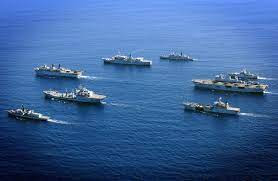
HMS Albion leading a multi-national amphibious force


            The Amphibious Force is often seen as one of the pillars of British maritime power; along with Carrier Strike and Trident. But with the ever-dreaded defence reviews seemingly never ending, amphibious capabilities are usually the first to go- the Navy has too much pride to get rid of the Carriers and scrapping the deterrent would have disastrous effects on the United Kingdom's global standing. This leaves only the Bootnecks left to cut for major savings. In this article, I'm going to propose a future force amphibious force that shares the burden of amphibious operations between all three services but still leaves us with a truly world class commando force.

Note: For a more comprehensive overview of Britain's future amphibious forces see my series Owning The Littorals


The Current Commandos

            Currently, the Royal Marines 'Commando' units (battalion equivalent) are commanded centrally by 3 Commando Brigade (3 CDO BDE). While technically forming a brigade, the Commando forces don't have enough combat or combat support units to operate as such, with 3 CDO BDE ssentially acting as a deployable HQ in a maritime environment. Under the brigade comes the Commandos, the fighting power of the Corps of Royal Marines.


            Two of the brigades Commandos follow the Commando 21 Structure, these being 40 CDO (forty commando) and 45 CDO (four-five commando). They consist of 6 companies- Command, Logistics and two each of close combat and stand off. The Command Company encompasses HQ functions for the CDO (through both the Main and Tactical HQs), the recce troop and sniper section, the Mortar troop (9 81mm mortars and 4 Fire Control Parties), Anti-tank troop (6 Javelin ATGMs), Heavy Machine Gun troop (6 .50 Calibre HMGs) and the signals troop. The Logistics troop commands all the 'rear echelon' parts of the unit; the 'A echelon', Forward Repair Team, Regimental Aid Post and 'B echelon'.
The commando 21 structure


The two Close Combat Companies provide the bayonet strength to the Commando and are made up of 5 officers and 98 other ranks divided into Company Headquarters and three rifle troops. Each troop consists of a manoeuvre support section (GPMG, Long Range Large Calibre Rifle and formerly a light mortar) and three rifle sections (2 four man fire teams and corporal in command) as well as a small troop HQ. This is complemented by a Fire Support Group and Company Headquarters. The entire company is transported by Landing Craft and mechanised by legs Mk.1. Overall, the company is not too dissimilar to an army light infantry company.

The two Stand Off Companies provide additional weapons support to the Commando, although they are capable of limited manoeuvre, and are made up of 5 officers and 78 other ranks. They consist of one close combat troop (identical to the three in the Close Combat Company, an Anti-Tank Troop (six Javelin ATGMs) and a Heavy Machine Gun Troop (six .50 calibre HMGs). One of the companies are wheeled using Jackal 2 MWMIK and one is tracked on Viking All-Terrain Vehicle (Protected).

 
           30 Commando information exploitation group (thirty commando IX) provide ISTAR support to the entire brigade. It is made up of 465 personnel (all ranks) and is named for 30 Assault Unit, a tri-service unit which gathered intelligence from behind enemy lines, whose organisation was planned heavily by Commander Ian Fleming (of Bond fame). The unit current organisation, however, is primarily Royal Marines and consists of four squadrons and HQ troop, who are responsible for unit administration. 

Surveillance and Reconnaissance Squadron (SR Sqn) provide the Brigade with its own organic recce capability. It has four troops; the Brigade Patrol Troop has six teams of four Marines who insert before the main force, scouting ahead in a similar style to UKSF units. Air Defence Troop operates Starstreak High velocity missiles to provide top cover to Brigade assets and the Royal Marine Police troop operate as force protection for Brigade HQ and provide  mentoring for partner nations. The squadron also has responsibility for Tactical Air Control Parties for the Brigade. Logistics Squadron provides Motor Transport, Catering, Stores, and Equipment support troops for Brigade on operations and at home while the Communications Squadron provides two satellite communications troops. This is rounded off by Y Squadron who provide electronic warfare assets to various levels of command.


            42 Commando are the 'specialist maritime operations unit' which means that they don't operate as a formed unit, instead deploying small, highly skilled teams around the world on Royal Navy warships and Royal Fleet Auxiliaries. Juliet Company are board and search specialists who board non-compliant vessels, mainly East of Suez and provide the Fleet Contingency Troop. Kilo Company are the Support, Augment, Liaison, Training (SALT) company, which means they provide teams to SALT other units (both UK and partner nations). Lima Company provide Joint Personnel Recovery on the Queen Elizabeth class carriers while Mike Company are force protection specialists for warships in high-risk areas.


            43 Commando Fleet Protection Group provides protection to the nuclear deterrent in and around HMNB Faslane and related establishments. The group is highly trained in maritime security, boarding operations and CBRN procedures. The unit numbers around 550 personnel and is divided between HQ Squadron, 3 rifle squadrons and the boat troop who operate three Island class patrol vessels, purchased of the Ministry of Defence Police and then up-armoured. The group also have a secondary role of assisting the Special Boat Service with Maritime Counter-Terrorism, especially in the North Sea Oil fields (although this is obviously a lower priority than protecting the deterrent).

 
           47 Commando provides landing craft support to the Royal Marines in the form of two squadrons of Landing Craft (4 Assault Squadron Royal Marines and 6 ASRM) both of which operate 4 Landing Craft Utility and 4 Landing Craft Vehicle Personnel. The Group also provides training to crews of the vessels and oversees training to partner nations in amphibious landings.They also command 539 Raiding Squadron RM who operate Landing Craft Air Cushions, LCVPs, Rigid Raiders and Offshore Raiding Craft directly under the command of the Brigade.


            The Commando Logistics Regiment provide Combat Service Support to the Brigade and draws its 780 personnel from the Royal Navy, Royal Marines and British Army (all need to have passed the All-Arms Commando Course). They are split into HQ Squadron, Equipment Support Squadron (provide repair and recovery to the Brigades equipment), Logistics Support Squadron (provide transport, fuel and stores to the Brigade), Medical Squadron, Landing Force Support Squadron (land directly behind front line troops to control beach movements) and the Logistics Task Group which is essentially a high readiness smaller scale formation made up from all elements of the Regiment, to support the high-readiness Battlegroup.

Under the command of the CLR is the Viking Squadron, which operates the Royal Marines BvS10 All Terrain Vehicle (Protected). The Squadron is manned by 162 Marines and is split into four independent troops of 16 vehicles each. Two of the troops are held at 5 days notice to move with the lead Commando group with the remainder of the squadron held at 28 days notice to move.

 
           24 Commando provides engineering support to the Brigade and is manned by 492 British Army personnel who have completed the All-Arms Commando Course. The Regiment is made up of four squadrons: 56 HQ and support squadron who provide HQ functions and recce, support and signals troops. 54 Squadron provide engineering support to the Brigade during amphibious assaults and 59 squadron is the Naval Support Squadron. These are all supported by 131 (Reserve) Squadron based in London.

 
           29 Commando provide indirect fires to the Brigade, both through their own guns and as fire controllers. It consists of HQ battery, two gun batteries of 6 L118 light guns and three observation posts,a Naval Gunfire Support Forward Observation (NGSFO) Battery with eight 6 man fire support teams and a training battery.

 
           The Commando Helicopter Force consists of 3 squadrons of helicopters of the Fleet Air Arm, operating in support of 3 Commando Brigade. 845 NAS operates 3 flights of four Merlin Mk4 transport helicopters while 846 NAS operates one deployable flight, the Merlin OCU and the Maritime Counter Terrorism Flight. They are supported by 847 NAS with 6 Wildcat AH1 Helicopters. These can be augmented by any other rotary and fixed wing assets in the British Forces and our allies; namely Apache, Puma, Chinook and USMC V22 Ospreys.


Current Shipping

            Along with the Marines themselves, the Navy's amphibious ships are vitally important to a littoral theatre entry. Without them it would be literally impossible to invade anywhere bar the Isle of Wight. In this section of the article I'm going to detail the Navy and RFA's current amphibious shipping.


            The Royal Navy currently operates two Albion class Landing Platform Docks or LPDs- Albion and Bulwark. They displace 19,500 tons and are 176 metres long. Each is crewed by 325 officers and ratings and can reach speeds of 18 knots with a range of 8,000 miles. The ships have a two spot flight deck capable of landing helicopters up to the size of a Chinook but lack a hanger. Each operates a landing craft squadron of 4 LCU and 4 LCVP from davits and the large well deck. An Embarked Military Force of 405 (710 overload) can be carried along with 67 vehicles.


            Operated by the Royal Fleet Auxiliary, the Bay class are meant to bring in 'second wave' troops in any major landings. They can carry 356 troops (700 overload) with 1,150 lane metres for vehicles. The ships complement is 70 RFA all ranks. Although their primary role is amphibious assault, the Bays are often seen operating as mine countermeasures command and support ships in the Gulf or disaster relief in the Caribbean. They have a Chinook sized flight deck and no hanger, although the effects of this are mitigated by the installation of a temporary fabric hanger.


            The four Point class strategic sealift ships are owned and operated by Foreland Shipping Ltd and permanently chartered to the MOD. They are crewed by around 20 British Merchant Navy Men, who are also Royal Naval Reservists. They can transport up to 130 armoured vehicles or four helicopters at a speed of 21 knots but have no passenger capability to speak of. They aren't usually used in the assault phase of an operation, instead providing follow on equipment. Most of the time however, the Point class are used to transport equipment between standing garrisons (the Falklands, Cyprus, Germany etc.).


Future Amphibious Forces

            The Future Commando Force is a programme designed to essentially take the Royal Marines 'back to their roots' of amphibious raiding from the sea, like the original army commandos of World War 2, rather than acting in a role practically identical to any number of light role infantry battalions the army is not lacking, to say the least. This includes trials with different unit sizes, including troops of sixteen and sections of twelve and new technology, drones and unmanned ground vehicles. They also tested out new vehicles, such as the Polaris MRZR which is both air-portable by Merlin and incredibly ally and gave every marine a tablet as part of the ATAK (Android Team Awareness Kit) system; essentially kit which can be used for displaying data from UAVs and providing a location of friendly forces, greatly improving situational awareness both for the man on the ground and in HQs at every level from section to Northwood. The trials also included more symbolic changes including adopting the White Ensign instead of Union Flag on the Marines' left arm, adopting a separate uniform from the Army and the adoption of the Colt Canada C8 rifle instead of the SA80 as the primary individual rifle.

LRG organisation (Image credit: Navy Lookout)


The aim of the FCF is to deploy the Marines permanently aboard ships in 'Littoral Response Groups'. Two will be formed; LRG(North), based in the UK and responsible for the Atlantic, Baltic, Mediterranean and the Arctic and LRG(South), responsible for the Persian Gulf and Indo-Pacific which will be permanently based at the UK Joint Logistics Support base in Oman. LRG(N) will be made up of an Albion class LPD, Bay class LSD (plus escorts) and a Littoral Strike Unit consisting of a company group from 45 CDO and various supports from the brigade level. LRG(S), however, won't have the luxury of the LPD and LSD so will have to make do with a refurbished RFA Albion, but will, ironically have better aviation support from a fifty year old former container ship then LRG(N) will from two modern(ish) purpose built warships.


Fantasy Fleet Time!

            Now we have the context behind the current structure and theory of the Future Commando Force, I'm going to have a crack at my own fantasy amphibious force. I'm going to try and stay just about within the realms of reality budget-wise(ish!), and try and follow the doctrine of the Future Commando Force. This means that I'm going to expand on the ideas the theory is built around namely forward-deployed, light, expeditionary troops able to operate in independent company groups, away from any support not organic to the group.

 
           In keeping with the FCF plans, I would still forward deploy Groups both to the Gulf/Indo-Pacific region and the High North. Each group would be made up of a 'Littoral Strike Unit' of around 250 Marines from 45 Commando in the North and 40 Commando in the South and supporting units, half an infantry Battlegroup, a Landing Craft and vehicle squadron from 47 Commando, an aviation group from the Commando Helicopter Force, a Type 83 Destroyer, Type 26 frigate, Landing Helicopter Dock and a Littoral Strike Ship. This would all come together to form a well-rounded group optimised for raiding and small scale insertions which is entirely self contained. The exact composition of small units will obviously need perfecting with trials and experimentation (which has already began with the LRG[X] deployment) but should be reasonably easy to work with.


            I'm going to start with the simplest part and talk about the naval component of the group, which will be made up of a Type 26 frigate and Type 83 destroyer. The combination of the two gives the task force a potent and organic ASW, AAW and ASuW capability. Currently, the Type 32 frigate is expected to provide support to the LRGs but I would use them to provide depth to the forward deployed Type 31s.

The Littoral Strike Ship probably deserves it's own article but, in essence should be a part of the Multi Role Support Ship as it currently is pencilled in to be. Currently, the MRSS is going to be six ships to replace the Bays, Albion and Argus. I would however, change the programme fundamentally to be not a group of identical ships to instead being a group of ships will the same hull, engines and systems. They will be based on whichever design wins the Fleet Solid Support Ship competition and will have up to twelve hulls; four FSSS, four LSS and four Hospital ships (funded by the DFiD) plus whatever export orders we can secure. As I said earlier, I'm going to write an article about this proposal sometime in the near future but for now, I'll outline the LSS variant. 

The LSS should be based on the FSS (probably Team UK's proposal) meaning it will be 220 metres long, 30 metres wide and have a draught of 7 metres. There would be space for a two spot flight deck at around the same height as the top of the hanger in the image which would stretch roughly to the funnels (which would be heightened to the same level as the main superstructure). The large hanger would sit between the funnels and the location where RASCO is (although that would be deleted), just forward of this would be a large opening on both port and starboard so the LSS can operate in a similar fashion as the US Navy's Expeditionary Dock, moving cargo and vehicles between strategic RO-RO ships (in our case the Point class but could well be allied shipping or STUFT) and landing craft. This would be connected to a stern ramp for RO-RO and several decks for vehicle movement and stowage. To top this all off, would be the three decks seen, extended all the way aft for accommodation for embarked forces.

Team UK's FSS proposal

To round off the group is the flagship of the force, a Commando Carrier. This will be a similar size to the Juan Carlos class (or Canberra class if we feel AUKUSy today) Landing Helicopter Dock but I have brought back the term for the Centaur class because they will both literally carry Commandos and operate fixed wing aviation plus it sounds way more impressive. The class would have a flat top capable of operating F35B Lightnings as well as rotary aviation. A well deck for amphibious shipping would back onto the vehicle deck and an aircraft hanger would be necessary.


            The LRG is provided with a capable air group of one squadron of 12 F35Bs (primarily for CAP over the naval element- if anything else is needed then a Carrier Strike Group should be added), four Chinooks if they can be marinised, eight Merlin HC4s and eight Apache attack helicopters as well as the escorts own organic aviation assets. This would be augmented by UAVs when this technology has matured
properly.

 
           This may sound good but to land troops on the ground you need, well, troops on the ground. This will be provided by 40/45 Commando Royal Marines, but these will only deploy smaller formations of around a company group size. Each would be made of three large troops with engineer, artillery (in the form of fires controllers) and medical support.

To provide mass to the Marines, I would reflag 1st Division as a more expeditionary focused organisation to provide a rapid reaction capability worldwide, making it a fully deployable division. It would take command of a variety of the Army (and Navy's) lighter brigades, including 3 Commando. The lighter RM raiding force would be augmented by a half-battalion (I would reorganise the Division's Infantry into a structure similar to Commando 21) of one Close Combat and one Stand Off Company and a small HQ/logistics element. This would be augmented by a Cavalry Squadron, artillery battery with 120mm Mortars, engineer troop, medical teams and an ISTAR squadron. The entire Battlegroup (or as much as feasibly possible within equipment constraints) would be mounted in MRV(P) which should really only be a single vehicle instead of the several different packages currently planned for (my favourite is Bushmaster but any will do) in LRG(S) and F-ATV(P) in LRG(N).

 
           A landing force is obviously useless stuck aboard a ship, they need a way to get from ship to shore-back in the old times, this would be done solely with landing craft. The US Marines tried to use aviation solely and then found that while this might work well in the assault phase of any landing, by the time the main forward elements have a solid foothold on the ground, aviation cannot keep up with demand (remember this is the USMC, who have much better rotary wing support than virtually our entire forces, never mind the CHF) so even they had to bring back small vessels. These are currently the LCVP Mk5 and LCU Mk10 for the Royal Marines and are both in essence evolved designs which wouldn't look out of place on Sword beach. This is not in itself a bad thing, but has it's drawbacks on the craft's speed- the LCU has a fully laden speed of 10 knots. I think both of these need replacing with completely new designs.

I would replace the Landing Craft Mark 5 with the CB90 or similar. It increases the speed over the LCVP from 25 knots up to 40. The craft is a flexible and well proven design and can be armed with a variety of weapons systems including but not limited to M2HB HMGs and Grenade Machine Guns. This could, of course, all be adapted to suit the raiding teams needs and whatever equipment becomes available in the future. One of the potential downsides of the CB90 (aside from the price tag) is the smaller load (only 21 fully loaded troops to the LCVP's 35) and the CB90 cannot carry vehicles, although as 'light vehicles' get bigger and much heavier the LCVP can't carry much more than a Land Rover anyway.

The LCU should be replaced by a large hovercraft. This would be similar to the type used by the USMC rather than the in service (or recently retired?) type used by 47 Commando. Hovercraft have the advantage of being able to access up to 70% of coastlines around the world (compared to 15% for conventional landing craft) as well as not needing complicated wet docks to be launched from ships, instead essentially just needing an opening to drive straight out of. 

 
           That, with some investment, leaves us with a credible, modern and agile amphibious force, fit for any expeditionary warfare around the globe at many scales. Imagine, for a moment, a terrorist group seizing power in a small West African country. LRG(South) steams towards the nation immediately, with her embarked forces preparing. The group gets within ten miles of the coastline, launching her landing craft and helicopters laden with Marines and soldiers. A company, 1 LOAMSHIRES form a secure perimeter around the beach zone where the Hovercraft came ashore, allowing British citizens to be safely and efficiently evacuated to the ships, where medical and humanitarian attention is waiting. Meanwhile, the commandos head towards the British embassy, where sensitive material is destroyed and the entire staff evacuated by helicopter before the entire force pulls out, mere hours after the evacuation began.

Now think to the Falkland Islands, where by some strange course of events the Argentinians have managed to land a force and secure Mount Pleasant before reinforcements can arrive. Both LRGs head for the South Atlantic, having been reinforced by the rest of the battalions on amphibious duties at the time, as well as the two battalions with the most recent amphibious experience, forming an ad-hoc brigade under 3 CDO BDE HQ. The deployed Carrier Strike Group head towards the islands too, with the 'building up' group making preparations to sail immediately. The group lands first wave forces near Bluff cove, being followed up by troops brought down on ship taken up from trade and then transferred (with all their equipment) through the LSS' onto landing craft in preparation for the final push on Stanley. 

However unlikely, these examples show the main benefits of my proposal- it is scalable from company to brigade level and can deploy an entire amphibious brigade without having a committed amphibious brigade at high readiness at all times.