06 June 2023

Make Do And Mend

 Make Do And Mend

An Introduction


           Ajax is a name almost synonymous with everything wrong with defence procurement in the modern government, probably one of the longest, most reported on and costly cock-ups the MOD has ever seen. Due to a massive amount of engineering defects - not least the fact that personnel involved in the trials are now partially deaf - it was up in the air whether General Dynamics would actually be able to get the vehicle into service but a series of positive press releases seem to be suggesting the worst of the vibration issues have been overcome.


            With the billions sunk into the project, and the unfortunate likelihood of war in Europe within the next decade, Ajax is needed.

            But a rather large reconnaissance vehicle isn't all that's needed; wholesale change within the Army is required to bring the Army back into the modern era. A strategic plan needs to be formed, optimised but not completely focused around the Russian thread.

            This would require a force that can fight across most of the spectrum of warfare, from farmers in flip-flops to full peer-on-peer combat. This means we can't afford to look solely at one threat, and that any force needs to be expeditionary by design - basically the only certainty in this context is that we won't be fighting in Great Britain.

            With this in mind, we can construct our force around a few main trends and points, using trends from conflicts past and ongoing and various studies notably Colonel D. Macgregor, US. Army (ret)'s Reconnaissance Strike GroupConceptual Force 2035 and various organisational structures from allied (and other) armies around the world. This leaves us with a few key takeaways, namely:

  • Long Range Indirect Fires integrated at all levels of the Conceptual Force, from Mortars and Non Line Of Sight Short Range Missiles at Company level to Precision Strike at Divisional Level - allowing destruction of enemy positions without significant infantry assaults needed.
  • Significant use of Anti-Tank Guided Missiles, in every cavalry troop and infantry platoon - both mounted and dismounted, direct and indirect, reusable and disposable variants. 
  • Integral Reconnaissance assets at Battlegroup, Brigade and Divisional Levels, using both covert, small teams and systems and full-scale fighting for information - with various weapons types up to MBTs.
  • Remotely Crewed Systems for both reconnaissance and strike, integrated at all levels (noticing any patterns here) and adding extra levels to the Conceptual Forces' situational awareness.
  • More and meaningful co-operation with allied forces, culminating with a British heavy division operating within an allied Corps.

            Any future force needs to be able to act and respond to any threats that could come about across the medium to long term (I'm defining medium as about 5-7 years and long as 7+) while not ignoring the Bear in the room, so to speak. I would suggest that, to that end, the army focus' right now on maintaining a singular hard as nails armoured Brigade, with the intention of expanding over the medium term. The force should then aspire to maintain several levels of operation, either:
  • One Armoured Division, either as part of a UK-led, mainly UK operation or as part of an Allied Corps, as a one shot deployment.
  • One Armoured/Mechanised Brigade as part of a wider Allied formation, contributing a Divisional HQ and specialised troops occasionally, indefinitely as part of a rotational deployment
  • An armoured Battlegroup to a multinational deployment indefinitely as part of an allied operation, while maintaining a presence in Estonia.
            What this means in fighty terms is that the Army should aim to complete an Iraq 91, Iraq 04, or KFOR+Cabrit while maintaining a lighter force for a Falklands style operation at all times.

            What this means in practice is that smaller all-arms formations with masses of indirect fires, able to operate in small Battlegroup sized formations all the way up to Divisional level (as part of a multi-national corps). For this, our tried and tested* (*note - not actually tried and tested, who do you think I am?) plan is going to need several planning assumptions, notably:
  • Any more money that becomes available is going to be spent primarily on upgrading and enhancing already in service or ordered systems, with no new 'big ticket' procurements (that means no CV90, sorry!)
  • The army isn't getting bigger, so plans have to be near enough manpower neutral (or have a reasonable place to steal manpower from)
  • All already ordered platforms need to be used as procured, although small modifications (after initial entry into service) are acceptable
  • For Multi-National operations, interoperability with the allies we expect to work with the most is always a good thing™
  • The Land Industrial Strategy should be kept in mind as far as possible (although promptly ignoring it wouldn't make much of a change)
            Bearing in mind the above, I think that the optimal armoured division would be a relatively large square division, with both wheeled and tracked platforms.

            The wheeled platform would obviously be Boxer, and potentially a cheaper companion, while the tracked platforms would be Ajax, Challenger 3 and eventually it's replacement.

            Overall, the Division should be formed of two armoured, two mechanised, one Deep Reconnaissance & Strike Brigade, an Operational Sustainment Brigade, and a Headquarters and security brigade.

            In this little series of articles, I'm going to outline my thoughts on this structure in quite a bit of detail, but first we're going to discuss the main problem preventing it's implementation: the cap-badge mafia.

01 May 2023

Owning the Littorals - My Planning Assumptions

 Owning the Littorals

My Planning Assumptions


Owning the Littorals is a series by BMR on the merits and capabilities of amphibious forces and what I believe their future should be. View the full series here and part two here.


            I love a good fantasy force, you probably love a good fantasy force too, everybody loves a good fantasy force. This includes many people in Main Building, I'm assuming. In this article, I'm going to outline some of the assumptions I've made in planning my own fantasy force, based on the Future Commando Force's own assumptions (assumptions always have to be made). I've tried to consider as many political, social, and strategic consequences as I can think of; however some have probably slipped through the gaps - so feel free to discuss over on Twitter.


Assumption One - The Army

            The first assumption I've made is that all Army supports to the Commando Brigade will remain at the same or similar levels - both of manning and equipment (although I will very much be making allowances for upgrading some equipment available to the Littoral Strike Groups). This is justified, in an army increasingly stretched for manpower, by the fact that the LSGs will act as a 'plug and play' out of area HQ unit - so army operations will be directly supported by their own supports.

            Number-crunching wise, I'm going of the assumption that the Commando Logistic Regiment has about 200 Commando-trained Army personnel under it's command (further breaking down, I'm going off a 50/50 RLC/REME split), 24 Commando, RE has approximately 492 Gunners under it's command and 29 Commando, RA has 430 Army personnel under it's command (my assumptions are 390 RA, 20 REME and 20 RLC. 33 Engineer Regiment (EOD) has either one or two Commando EOD troops (sources contradict each other here) under it's command - approximately 50 personnel, all trades.

            The final and biggest assumption on the part of the Army is that the North/South split is going to be embraced across Defence - primarily in the Army. This probably deserves it's own stand alone article but in brief 11 Brigade would be lose the Security Force Assistance role (with no replacement) and 11 and 4 Brigades would support the North/South split. These would use forward deployed troops (Cyprus in the North and Brunei, Oman in the South) to provide acclimatised presence wherever needed. These could also be deployed at sea with the LSGs to provide a larger force if needed - similar to the Australian approach.


Assumption Two - The Navy

            For amphibious operations, amphibious shipping is a prerequisite (unless we're invading the Isle of Wight). Currently, this is the two Albion class (although one is in extended readiness), three Bay class and RFA Argus. The longer term plan is that all six of these are to be replaced by a singular 'Multi-Role Support Ship'. Also planned to be in service by the middle of next decade (although in early design stages), is (up to) five Type 32 frigates.

            Completely unrelated, is the procurement of four Logistics Support Vessels to support the new ARCIMS unmanned Mine Counter Measure vessels. Without going into too much detail, I would reduce the number of (Royal Navy crewed) MRSS to four and use the savings to buy four much larger, much more useful Logistics Support Vessels (which would have use in amphibious landings). 


Assumption Three - The Air Force

            The RAF Regiment provides an unknown (to me) number of Tactical Air Control Parties, which would presumably remain the same. But because I need to bulk out this section more than a line and a half, I'm going to include Joint Helicopter Command here as well.

            I'm making several rather bold assumptions; the boldest being that the Treasury will allow the Fleet Air Arm to buy a tilt-rotor aircraft (presumably not Osprey). They have a price tag (and quite a big one at that) but a tilt-rotor aircraft would give the Queen Elizabeth class the ability to operate fixed wing AWACS and COD capabilities - freeing up most of the Merlin Mk.2 for ASW and the Mk.4 for Commando operations. Yes, it would be expensive, but more expensive than a £3 billion Aircraft Carrier and 900 Sailors? This means 16 Merlins would be available to the LSGs, along with four Commando Wildcats and around 14 Naval Wildcats.

            I'm also going to take forward basing to the extreme, a little bit, and assume that the Army can forward base a not insignificant aviation element East of Suez (Brunei would make sense, working from the already existing AAC airfields). This would aid in both Commando and Army operations. A notional Army contribution to the CHF would consist of 12 Apache and 12 Chinook Attack and heavy lift helicopters.


Assumption Four - Terminology and TLAs

            All the literature available online about the Future Commando Force (or FCF) is filled with absolute mountains of TLAs and TLA(B)s. From what I can work out the standard building block is due to be the Littoral Response Group (LRG), North or South (LRG[N] or LRG[S]). Each is made up of one Littoral Strike Unit (LSU) made up from a Commando Strike Company (CSC) from 40 or 45 Commando, along with supporting elements from across the rest of the Commando Brigade and is supported by a naval force made up of either HMS Albion or RFA Argus (in the North or South, respectively), a Bay class LSD, at least one surface escort and a logistics vessel(s).

            When both LRGs combine for larger operations, they form a Littoral Strike Group (LSG) and when this is complemented by one of both of the Queen Elizabeth class carriers, this creates an Expeditionary Strike Force (ESF).


Assumption Five - Allied interoperability

            The Royal Marines have traditionally maintained very close working relationships with allied Marines, most notably the USMC and Royal Netherlands Marines Corps. I'm making the assumptions that this will continue and the Royal Netherlands Marine Corps will also change to follow a similar structure to the LRGs, perhaps based off of the Rotterdam class (or their successor, perhaps a chance for international shipbuilding design co-ordination)?

            Working with the USMC would certainly continue, although similarities are obviously much less obvious than with the Netherlands. Interoperability would therefore have to be based on mutually supporting each other and working to each forces' advantages. Also important to note is that the Australian Defence Force have recently improved their amphibious force significantly, perhaps their is scope for working together - what with AUKUS and all that.


Appendix One - My Planning numbers (Personnel)

            My planning numbers, which I have tried not to exceed at all during my thought exercise, are as follows - although this needs to be taken with a full shaker of salt, number denoted with an e rough estimates, based entirely on educated guesswork and (00+00) corresponds to regular and reserves respectively:

-Royal Marines Total Strength: 6,650 (5,968+682)

-Royal Marines Total (including attached Army units): 7644 (7531+113)

-Royal Marines General Duties (Infantry) Officers: 58

-Royal Marines General Duties (Infantry) Other Ranks: 551

-Royal Marines General Duties (Board and Search) Officers: 5

-Royal Marines General Duties (Board and Search) Other Ranks: 75e

-Royal Marines General Duties (Support, Augment, Liaise and Train) Officers: 5

-Royal Marines General Duties (Support, Augment, Liaise and Train) Other Ranks: 75e

-Royal Marines General Duties (Joint Personnel Recovery) Officers: 5

-Royal Marines General Duties (Joint Personnel Recovery) Other Ranks: 75e

-Royal Marines General Duties (Force Protection) Officers: 5

-Royal Marines General Duties (Force Protection) Other Ranks: 75e

-Royal Marines General Duties (Nuclear Force Protection) Officers: 30

-Royal Marines General Duties (Nuclear Force Protection) Other Ranks: 520

-Royal Marines Heavy Weapons (Anti-Tank) Officers: 4

-Royal Marines Heavy Weapons (Anti-Tank) Other Ranks: 39

-Royal Marines Heavy Weapons (Air Defence) Officers: 1

-Royal Marines Heavy Weapons (Air Defence) Other Ranks: 35

-Royal Marines Heavy Weapons (Mortars) Officers: 2

-Royal Marines Heavy Weapons (Mortars) Other Ranks: 88

-Royal Artillery Commando Officers: 20 

-Royal Artillery Commando Other Ranks: 410

-Royal Artillery Commando Fire Support Team (All Ranks): 48

-Royal Marines Communications Officers: 8

-Royal Marines Communication Other Ranks: 78e

-Royal Marines Assault Engineer Other Ranks: 48e

-Royal Engineers Commando Officers: 25 (20+5)

-Royal Engineers Commando Other Ranks: 472 (412+60)

-Royal Marines Armoured Support Officers: 15

-Royal Marines Armoured Support Other Ranks: 250

-Royal Marines Combat Intelligence Officers: 5

-Royal Marines Combat Intelligence Other Ranks: 19e

-Royal Marines Landing Craft Crewman Officers: 8

Royal Marines Landing Craft Crewman Other Ranks: 120

-Royal Marines Logistics Officers: 12

-Royal Marines Logistics Other Ranks: 130e

-Royal Marines Communications Exploitation Officers: 4

-Royal Marines Communications Exploitation Other Ranks: 18e

-Royal Marines Information Systems Officers: 3

-Royal Marines Information Systems Other Ranks: 17e

-Royal Marines Police Officers: 1

-Royal Marines Police Other Ranks: 34e

-Royal Marines Sniper Other Ranks: 75e

-Brigade Patrol Troop Other Ranks: 24

Appendix Two: My Planning Numbers (Vehicles, Watercraft, and Aircraft)

            My planning numbers, which I have tried not to exceed at all during my thought exercise, are as follows - although this needs to be taken with a full shaker of salt, number denoted with an rough estimates, based entirely on educated guesswork:

-16 Merlin Mk. 4 available to the CHF, with more in reserve and repair

-8 Wildcat AH1 Light Attack Helicopters, four need to be acquired from Army stocks

-8 Wildcat HM2 Naval Utility Helicopters, with more available to the wider fleet

-12 Chinook, based and training alongside Littoral Response Groups, although prolonged shipborne deployment should be avoided

-12 Apache AH-64E, naval deployments have been accomplished in Libyan operations, 6 forward deployed with LRG(S) could operate with Army and partner forces across the Indo-Pacific

-4 Littoral Strike Ships, with two based in each area of responsibility - have accommodation for a significant amount of marines, stores and equipment (with ability to RAS with escorts), a dock, large flight deck and hanger

-4 Logistics Support Vessels, based on a commercial conversion with a flight deck, steel beach, large crane, cargo decks, workshop and At-Sea Transfer of stores capability (think of the US Expeditionary Transfer Dock on Meth)

-12 Landing Craft Utility replacements, with the capability to transport an MBT, and transfer fuel and solid stores to smaller craft - as well as a winching deck which can also land and operate medium sized RPAS

-36 Novel Amphibious Craft, to replace both the LCVP and ORC - with the ability to transport a troop of Marines and some light vehicle types

- 12 Landing Craft Air Cushion, hovercraft with the ability to carry a Viking or Coyote and several dozen Marines, like the British built Griffon 8100TD

-6 Beach Armoured Recovery Vehicles, using an Ajax chassis could help get rid of some of them while providing commonality the Hippo severely lacks

-110 Viking ATV(P), to provide both Royal Marines and British Army units with littoral armoured mobility.

-Various Jackal/Coyote and Polaris MRZR to provide high speed mobility to small teams of Commandos


Appendix Three- My Commando Force Operational Concepts

            The Commando Force would be tailored to meet several different operational levels, with a small force available at all times but large scale amphibious operations would need some level of warning for a force package to be assembled. These 'force packages' would consist of a enduring, reinforced,  Contingency and Warfighting.

Enduring - R0 (deployed or deploying) with ~400 Marines available in each area of operations, for use in humanitarian aid, non-combatant evacuation, small-scale raiding, special forces support

Reinforced - R3 (10 days notice to move) with ~800 Marines and a motorised Battlegroup for very small scale theatre entry or raiding operations.

Contingency - R4 (20 days notice to move) with ~1600 Marines and two motorised Battlegroups, with two Mechanised/Armoured Battlegroups and a Brigade HQ preparing for transport on chartered shipping.

Warfighting - R5 (30 days notice to move) with ~2600 Marines, a motorised Brigade and a Mechanised/Armoured Brigade ready to reinforce on chartered shipping for very large scale theatre entry operations.


            The enduring force package should be met in both areas of operation the vast majority of the time,  the reinforced package should be able to be deployed in both around half of the time and the contingency and Warfighting packages are a 'one-shot' deployment -in a singular area of operations, probably with both aircraft carriers, and significant allied forces.


In Part Four, We'll begin discussing a tentative Order Of Battle for the Future Commando Force at the highest levels.


25 February 2023

Joined Up Thinking*

Joined Up Thinking*

*Or lack thereof


            British foreign policy is a mess. Every week there seems to be a different 'emergent threat' which is then duly completely disregarded by every government department, who pursue there own pet projects. This approach to foreign policy is imperfect to say the least - it means that HM Government and UK plc. have no focus, which impacts the economy, national standing and international impacts of our country. In this little article, I'm going to take a look at some of the priorities all government departments should be looking at and how these would affect the Armed Forces.


Priority One - National Resilience

            The war in Ukraine and soaring energy prices have brought the debate about national resilience closer to the front of people's minds, especially with the realisation that onshore (and off our shores too!) energy reduces our reliance on the whims of foreign nations (whether expansionist nutters or just French) and might even save the consumer some money. Personally, I (and probably most of you too) believe that as much as humanly possible should be done to increase national resilience in several critical areas - most notably gas, food, medical equipment and ammunition. 


            With the UK's pivot away from natural gases, and the plan to achieve Net Zero before 2050, it seems almost certain that stocking a massive warehouse full of coal probably isn't the best way to go around this - after all, HM Government loses all credibility to try and get industry to pursue the move from fossil fuels if it is simultaneously filling up a bunker with the shite. 

            Therefore, the government should probably take the short term financial hit and invest in Rolls Royce's Small Modular Reactor concept, currently in the development stage. RR are planning on building significant portions of them in a factory, somewhere in Northern England or Wales (levelling up) and then performing the final assembly on site (SMR estimates that 90% of assembly is under factory conditions). The SMR is around 10% of the size of a conventional nuclear power station, so could potentially physically replace existing infrastructure, and could generate the same amount of power as 160 onshore wind turbines do - enough to power around 225,000 homes (twitter, correct me if my maths is wrong).

SMRs even look good too -trees!

            Small Modular reactors (in concert with larger traditional nuclear reactors) could provide a baseline of electricity, along with Wind Turbines, strategically placed ones can provide significant power (for example, the Orkney Islands could produce enough wind to power a significant proportion of the Scottish Highlands - government investment could make this happen relatively cheaply, by simply upgrading existing cables). Solar and other renewables could provide an extra surge capacity for the five o'clock rush or when the adverts start during Emmerdale. 

            But how could defence help with this, it is obviously a cross-departmental effort. The MOD could start by championing Rolls Royce's expertise of nuclear reactors (indeed, they've been building them for the Navy for nearly three-quarters of a century) and then perhaps even power Salisbury Plain, or Catterick Garrison with one (they could even use these to power the very reliable electric cars they've bought). 


            Food wise,we have absolutely no chance of being able to produce the entire food needs of this country onshore. Even if the entire population survived on a diet consisting entirely of potatoes, carrots, beef and Mr Kiplings' Cherry Bakewells washed down with Iron Brew and Newcastle Brown Ale, it would be doubtful. Indeed, this has long been one of Britains' greatest weaknesses, with both the Kaiser and Hitler seeing starving the population as their best chance at defeating us.

            We should however, try and create a national stockpile of staple foods and other vital supplies (soaps/hygiene products, paracetamol/ibruprofen and baby products, for example) with the aim of holding enough supplies for around three or four months of absolutely no food imports at all. This could potentially be a job for the MOD to run, perhaps using veteran sub-contractors to assist.

            This would be quite expensive to set up however, but the cost could probably be offset quite a bit if a sensible approach was taken to the food packages. If a package consisted of something similar to the current 24 hour ration pack (which has a shelf life of 2 years), then they could be held in storage for a time of crisis for 12 months and then sent out to be used by the Field Army, Cadet Forces or Families in Need at home or abroad. A similar approach could be taken with the non-food items - although the Army probably won't be needing that many nappies. 


            Ammunition availability  is another problem we might come across in wartime, with Ukrainian forces using up significantly more ammunition than NATO has planned for. The MOD needs to seriously increase it's ammunition stocks in every calibre used (although it should be limiting the different types) and should have at least one (but preferably several) onshore manufacturing facility for 5.56 and 7.62 NATO standard small arms ammunition, 81 and 120 mm mortar bombs, 30 and 40 mm Medium calibre (for naval guns), 40mm CTA, 155mm artillery shells and 120mm smoothbore rounds as well as all our favourite guided munitions (say the line everyone). 

            Truth be told, we're not actually that far away from doing all of this. BAE can manufacture 5.56 and 7.62 at a rate of over a million a day and manufacture 81 mm mortar bombs in Washington (the machinery is capable of making 120 mm rounds with minimal re-tooling). CTA is all fine (BAE have even made 100,000 rounds of it - despite the fact that there's not even a cannon capable of firing it in service yet), 20 and 30 mm rounds are manufactured in Monmouthshire and - with the decline of the 20 mm cannon in naval service - it would be advantageous for BAE to establish a 40 and 57 mm line. 155 mm shells are produced onshore, as well, leaving only 120mm smoothbore not being produced. Considering that BAE make ammunition for the Challenger 2's unique 120mm rifled gun, I would assume they will re-tool that line for smoothbore - which also has a much larger export potential. 

            As well as having a large and scalable manufacturing capability, having a large enough stockpile for initial use in a major shooting war is also vital. The MOD stockpiles some amount in the UK however it would take a while to reach the frontlines (and relying on a small amount of facilities is risky, to say the least). It would, therefore, increase fighting power to set up relatively large ammo dumps in the SBA Cyprus, Estonia, Poland, Brunei, Oman, Bahrain and Singapore.


Priority Two - Foreign Aid

            Foreign Aid is the department of choice for defence commentators and right wing news hosts to advocate raiding to pay for whatever it is needs paying for this week. In all fairness, the DfID (or FCDO as they are now) don't seem to do the best job at distributing their budget, and sending aid to Pakistan and India - who both have nuclear weapons and space programmes - undermines the credibility and point of the department. 


            UK Aid as an organisation lacks many of the logistical supports needed to support emergency relief distribution, which is - for all intents and purposes - projecting power overseas. Take, for example, the Haiti disaster of 2010. The airport was severely damaged, as was the port, needing military intervention from US forces to transfer vital cargo to where it was needed. This came in the form of specialist survey/salvage teams and quite a few large amphibious vessels. 

            The undisputed masters of amphibious landings are the Armed Forces (obviously, it's not going to be the DVLA is it?). UK AID have the need to deploy medical and humanitarian aid to austere locations with almost no infrastructure and with minimal host country support (as there is a good chance local governance has completely broken down), the Armed Forces have an almost identical need in times of war. 


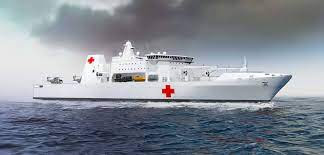
            This takes us on to what I think that the MOD and FCDO should collaborate on - developing and operating a class of Hospital Ships, for use supporting the Armed Forces in times of conflict and in peacetime supporting local civilian populations across the world. A joint funding programme would have to be worked out, perhaps with UK AID funding and paying to maintain the ships with the MOD paying running costs. 

BMT Ellida, configured as a Geneva compliant Hospital Ship

            The ships company proper would probably be RFA but medical teams wouldn't be. It would probably be advantageous to have a Ships Master and separate medical detachment commander, probably a Colonel or equivalent from defence. Having, say, four or five Role 3+ medical teams (with personnel from the Navy, Army, Air Force and Reserve components) would provide a continuously deployable force. The five teams would all be trained to deploy both at sea or in a field hospital. 

            Four ships would mean that a consistent cycle of maintenance, response, planned, response could be set up. Having two ships on a response deployment means that one can be based East of Suez and one West - allowing for quicker response times to incidents across the world. The remaining vessel on planned deployment could operate with a mainly civilian medical team (supported by armed forces helicopter and boat crews) from NGOs, medical students, the NHS or potentially even just general do-gooders in society. 


            Call them HMHS Maine, Bevan, Goodwill and Britannic after the name of about a million RFA hospital ships in the past, the founder of the NHS, the first Royal Navy hospital ship and probably the most famous (and sister of the Titanic). Assuming there's three medical tenders/landing craft on each, have a poll of the great British public to name all 12 - after all, that's never gone wrong before has it (HMHS Hospital McHospital Face). 

            More important than the physical infrastructure, however, is a sense of understanding between the departments - undermined by mutual respect and common sense. Everything possible should be done, both on the ground and back at Whitehall, to avoid a repeat of 3 Para's famous washing machine fiasco. 


Priority 3 - The Tilt

            The third priority the government is always waffling about is the rather controversial Indo-Pacific tilt. The tilt (not a full-scale pivot) aims to re-introduce a British presence East of Suez, a presence not seen on a significant scale since Wilson's premiership. The idea that the Indo-Pacific tilt is going to break down NATOs collective security by allowing the Russians to sneak through is, quite frankly, ridiculous. The actual hard commitment so far is two whole OPVs and a battalion of Gurkhas. 

            The cost of the Gurkha garrison in Brunei is paid for by HM The Sultan so has a negligible cost for the MOD and if Spey and Tamar were sent after the Russian Navy, the crew would probably mutiny. They are, no matter how well built, still just lightly armed patrol ships - not warfighting capabilities. The deployment costs barely nothing defence wise, £3.449 million is the average yearly cost of running a River class. But do we make more than £7 million pound from the links and relationships that Tamar and Spey are forging, I would say, probably, yes. 

            Although it can't be measured, I would hazard a guess that many friendships are being sustained by the White Ensign appearing in a harbour. 


            Imagine, just for a minute, that you're the President of a small Pacific nation, a population of, say, 1.5 million people, centred upon a little archipelago with 500,000 people living across the small islands and the rest living on the main island. You're trying to grow the nation's GDP but a large chunk of the nation's population are functionally illiterate and many people live in secluded communities, mainly accessed via canoe and/or Britten Norman Islander. 

            The police and local authorities are notoriously corrupt, with drug and human trafficking rings becoming more and more prolific. The country has been at peace since it gained independence in the late 1960's so, apart from the occasional token deployment of an infantry company and a couple of staff officers to UN missions in the area, the armed forces' (of less than 5,000 total) spend much of their time policing the country's maritime borders and trying to help stop the widespread police corruption. 

            The armed forces consist of a single brigade, with three infantry battalions, all lacking any transport except a small amount of Bushmaster PPVs (donated by Australia using slightly damaged vehicles brought back from Afghanistan) and a few antiqued lorries (barely in working order). The infantry is armed with SLRs, a few medium machine guns, sharpshooter rifles and a dozen or so 81mm mortars - reserve units are often stuck drilling with Lee Enfields. Artillery support is severely lacking - only a single battery of light guns, purchased second hand after some defence review or other here in the UK. The countries single engineer regiment (around 400 personnel in total) spends most of it's time trying to maintain the countries crumbling infrastructure. The logistics and medical force do likewise - spending more time trying to keep the country alive than training for their role. 

            The Air corps is in a similar sorry state. The singular ageing Huey helicopter hasn't flown in several decades and the small fixed wing detachment can't cope with the pressures caused by the trafficking rings as well as the masses of resupply missions needed to support the small communities. 

            Naval forces are just as bad, the entire fleet consists of a minesweeper that's literally falling apart, a single (quite small) OPV and a pair of newish Patrol Boats - again donated by Australia. The fleet (if we can call it that) is scarred by numerous incidents involving collisions with small boats and officers and ratings are poorly trained.

It all looks a bit bleak, doesn't it


            But now the Chinese turn up and ask you, the President, if you need some assistance on your island. In exchange for allowing their ships to dock, the Chinese government will fund a new port, airport and military infrastructure to go with the shiny new ships, planes and APCs they'll give you. You sign the deal immediately, after all why wouldn't you. 

            These Chinese fellas aren't all bad anyway are they? Sure, those Westerners are always decrying them as evil but why should we trust them - after all it was only 60 years ago when *REDACTED* troops were roaming our streets enforcing their brutal colonial regime. Most of their leaders were alive back then, many might have even been soldiers - occupying our land, stealing our resources and ultimately sealing our fate as just poor, backwards tribals. 

            That nice Chinese man didn't tell you about the loan though, did he? You thought the port was a gift from them to their newest ally. Of course it wasn't, you now owe your soul and all your money for the next century to our almighty overlord Winnie the Pooh, and there's nothing you can do. 


            But what can stop this, at our end (you're not the President of a small Pacific nation anymore, just some random English bloke -unless you're one of my 4 Bahraini readers, in which case you're just a random Bahraini now). Well, of course it's some good old Joined Up Thinking™ (Joined Up Thinking is a registered trademark of Think Defence Ltd, all rights reserved, yada yada). 


            Imagine, just for a minute, you're now a mandarin (I know, you get around a bit) sitting in your lovely home office, wearing the top half of your pinstriped suit (Pinstriped Y-fronts on show to anyone who walks into your spare bedroom), reruns of Yes Minister playing in the background. 

            What department you're mandarining for is irrelevant; it could be the MOD, FCDO, whatever the Board of Trade go by nowadays, like I said, irrelevant.  Now, your mate from the Foreign Office rings you up, and tells you about his shitty overseas job - he has to put his pinstriped trousers on and leave his spare bedroom, for Gods sake! 

Crikey, not my pinstriped trousers!

            Now, you do some snooping, as does your friend, and finds out what the President already knows about the state of this small Pacific country. (I'm not summarising, you all know the score). 

            So, with the power of speedy Joined Up Thinking™, a working group is convened on the country and a plan of action is created. It begins with gaining the trust of the nation's politicians and people (politicians are quite easy - booze at the embassy and/or state visit to London, the general public might be harder, but remember the Hospital Ship from earlier - that should do the trick). 

            Then Sandhurst gets busy, as does Dartmouth, Cranwell and even the Met Police college at Hendon, training the officers of said countries military, police and even civil service, why not. The Conflict, Stability and Security Fund can then provide the newly-trained military with with equipment - most of the funding ending up back in the Treasury's coffers if we provide them with British made rifle, handcuffs and pinstriped suits. 

            While all these land navigation, arresting and Mandarining lessons (watching Yes Minister - The Complete Boxset several times) are ongoing, the nice people at UK Aid and the British Forces travel to our Pacific island. There, they can train the locals and generally integrate into the local community. Basic infantry courses can be set up in most places, as can low level development of infrastructure (courtesy of the CRE) and local medical facilities can be developed - both people and equipment - with local doctors at the forefront of the programme - and with integration to avoid the washing machine fiasco, at the risk of sounding like a broken record. 


            So, there, you have it, with minimal actual spending we have simultaneously made an ally, helped out people in need and stopped Chinese expansion. All in a days work from your local expert at everything (that's me!)

BMR 

God Save The King

PS. Read this by Sir Humphrey, from the Thin Pinstriped Line blog

07 January 2023

Owning The Littorals - What's a Future Commando?

Owning the Littorals

What's a Future Commando?


Owning the Littorals is a series by BMR on the merits and capabilities of amphibious forces and what I believe their future should be. View the full series here and part one here.
 
           Over the past 20 years or so, the Royal Marines have found themselves utilised more and more as a plain old light role infantry brigade, taking their turn to deploy on OP Telic and OP Herrick just as much (if not more) than the Army's Brigades. However, with the return to contingency after the conclusion of combat operations in Afghanistan, it was decided that the illusion of a brigade-level amphibious assault should be dropped in favour of a focus on smaller unit tactics and raiding.


Landlocked Marines

            This began with experimentation using a company of 43 Commando exercising and wargaming in the UK, US, Gibraltar and Cyprus. The purpose of these was not to thrash the Yanks (which didn't happen) as the tabloids reported, but to try and experiment with how these small unit tactics could affect the battle at higher echelons - it was more fact finding than preparing for any imminent operation.

            The Vanguard Strike Company, as it was known, was given lots of leeway to trial and test out all sorts of tactics, small unit structures and equipment, begged borrowed and quite probably stolen from anywhere they could get their hands on. Some of the changes so far are slightly superficial; the adoption of a new uniform, for example, and the White Ensign being worn in the place of the Union Flag - although all these changes seem to be trying to bolster the additional emphasis on the Marines' naval role.


C8 and a Green Ensign

            Some changes have not been so superficial though, Vanguard Company have been experimenting with Unmanned Vehicles and loitering munitions (with the Switchblade 300 and 600 reportedly now being in service with the wider Corps) as well as new vehicles, like the allyest of ally wagons - the Polaris MRZR now spreading across the armed forces like an STI.


Can't carry much, but ally as fuck


            Most of these changes are intended to reflect upon the Corps' primary role as naval infantry, coming from the sea and melting back into it as soon as they arrived, and illustrating the point that their role is not to deliver massive forces across the shore but to land small groups of elite forces in dispersed spots across a coastline.

            These forces could accomplish a wide range of operations, from gathering intelligence, targeting enemy headquarters' with small raids to seizing and holding port facilities to allow heavier forces to disembark.

            To accomplish this, the traditional 30 man troop is being replaced by a much smaller 12 man Commando Strike Team, lacking an officer, instead being commanded by a Sergeant. Now - ignoring the obvious parallels with the US Marines micro-platoon, beefy little squad - 12 is a very nice number to work with.

            As any of you who learnt your times tables in primary school know, two sixes, three fours, four threes and six twos all equal twelve, taking a two man command element (commander and signaller) two five man teams could be organised.

            Now look at the Commando Forces' vehicles; the Wildcat carries six passengers, the Offshore Raiding Craft - eight, the Land Rover Wolf (if it's still going) six. Six Marines is half a troop, meaning two Wildcat's can deliver a troop - or three could deliver a troop and a couple of add-ons with a gunner in each. 

            It's a similar story with the ORC, a new programme to upgrade the thirty-nine strong fleet is underway - the upgraded model is going to be painted grey instead of the existing green (suggesting a bigger focus further out to sea) and known as the Commando Raiding Craft.


ORC10, the CRC prototype

            Upgrades seem to include standardising on a forward console (instead of having forward, centre and rear consoles) for the crew, increase the crew habitability and temperature control as much as possible in an open vehicle, upgrade the armour and weapons fit, install a Raymarine Quantum CHIRP navigation radar and a new removable transom for carrying the Commando Inflatable Craft (which has replaced the Zodiac).

            It is intended that two CRC's are to support a single Commando Strike Team, with fire and mobility support. For that purpose, all CRC's have mounts to fit either a GPMG or HMG on the port and starboard sides to the aft and a single GPMG mount (intended to be left empty in high sea states and long transits - the planning range is up to 150 nautical miles).

            The Royal Marines have acknowledged that this arrangement is sub-optimal - and that one Strike Team should travel in one boat. The Globe And Laurel article which discloses most of this information makes repeated reference to a new boat which 'is already being designed' to replace both the ORC/CRC and the Landing Craft Vehicle Personnel - due to be in service around the 2025 mark.


For illustrative purposes only, CB90 can't carry MRZRs


            This aligns nicely with a request for information put out by the Defence and Security Accelerator for a 'novel amphibious craft' able to
  • travel at sustained high speeds (at least 25kts) over a long range (up to 350 nautical miles) in Sea State 2
  • provide the ability to deliver personnel and light vehicles to a coastal access point with limited or no impact on operational speed/capability
  • relaunch and return from the coastal access point
  • operate with a low signature across all spectrums (thermal, radar, visual, acoustic, etc)  to reduce the probability of detection
            It needs to be able to do this with four crew (2 drivers, 1 coxwain, and a load master) while being configurable:
  • to carry and deliver up to 24 embarked persons and 4 crew fit to fight (considerations should be given to the environmental impacts on personnel and equipment)
  • to carry and secure 2x Light Vehicles and six embarked persons and boat crew (consider for calculations a Polaris MRZR(D). Each vehicle being approximately 3.56m long, 1.86m high, 1.51m wide, Curb weight 953 kg, Payload capacity 680kg.)
  • to carry and secure 2x Inflatable Craft and 2x Outboard Motors (OBMs) plus 14 embarked persons and 4 boat crew. (Consider for calculations an inflatable length 5.0m, width 2.08m, height 0.9m, weight 145 kg, Consider a 50hp OBM of 75kg).
            This all adds up to being an MOD attempt to see what information they can gain about the potential CRC/LCVP replacement. It seems logical that the Royal Marines would want to replace the ageing LCVP with something that could transport troops at much higher speed, and in much greater comfort than was previously achievable.

            The primary downside I can see to this approach is the loss of the LCVP's other role - namely V for vehicle. However, after the Snatch situation in the early 2000's, most vehicles have been getting bigger and bigger so the ability to transport even the lightest of the bunch is getting less and less useful - above the likes of the MRZR and Skidoo sit Jackal, which I've never seen in an LCVP.

            Assuming, however, the compartment for the two MRZRs is 7.5m long, 1.8m wide and 1.85m tall (which seems like a probable size needed to quickly manoeuvre out of) then seven NATO standard pallets could be accommodated inside the boat.

            We can also see the new 12 man centric theory at work again - each boat could carry two Strike Teams, Half a Strike Team on MRZRs or a Strike Team and two more Marines to operate the Commando Inflatable Craft.

            Another innovation of the Future Commando Force is the use of drones, Unmanned Aerial Vehicles, Uncrewed Air Systems or whatever we're calling them this week. (I'm going with Unmanned Systems, or the RAF's RPAS initialism - and I'm dying on this hill).

            Although not only a Commando Force innovation, small RPAS are featuring heavily in basically everything the Royals are doing, in use for practically anything - from improving situational awareness at the section level to blowing stuff up.

            The RPAS are complemented by the Android Team Awareness Kit (or iPad, to you and me) allowing commanders at the lowest level to improve situational awareness, whether by linking to data feeds and live imagery from his own organic man-portable RPAS or receiving images from higher level reconnaissance assets.

            These include several different types ranging from the Anduril Ghost, a man portable design, all the way up to the G3 Systems designed Heavy Lift UAV. The Ghost has a maximum flight time of 55 minutes, can be readied for operation by a single operator in three minutes, is capable of operationg near-autonomously in swarms and is practically silent.

            The Heavy Lift UAV was procured under the PODS umbrella, meaning that everything needed to operate the system, and the system itself, is contained in a 20 foot ISO container - improving deployability greatly. (As an aside, sticking one on the River class OPV in the Caribbean would probably help in hurricane season.) 


Drone in a box

            Having the ability to carry relatively large payloads will significantly aid the Commando Forces' ability to transport heavy equipment without having to drag it around - and the ability to transport a casualty is interesting, to say the least.

            It is also known that Switchblade loitering munitions are in service with the corps, but not to what extent.
            
             Switchblade 300 is a small (about two foot) loitering munition which can be transported and operated by a single soldier - the whole system weighs less than 3 kg. It has a maximum range of 10kg and a ten minute loiter time. Handily, it is controlled by a ground control system identical to that of the Puma UAV (also in RM service), and both platforms can theoretically be controlled by the same station simultaneously. The explosive is roughly equivalent to a 40mm grenade, and has been air launched from a USMC Osprey - perhaps this could be a useful addition to the Wildcat (in army service as well).


Just like the mortar, innit?

            It's big brother, the Switchblade 600, weighs significantly more - the full system being over 50kg - but can be assembled in less than ten minutes, and breaks down to technically man portable levels (although the man porting it would probably disagree). It has a maximum range of 80 km (although relay stations need to be utilised to achieve this) and a 20 minute loiter time at 40 km - the punch is a similar warhead to that found on a Javelin ATGM, giving indirect anti-tank capabilities to the Marines.

            More unmanned systems are either in service or soon to be in service but, like much of the FCF programme, not much is known and press releases are very limited.

            In the next part of this article, we're going to discuss what I think the Commando force can and should provide at readiness for amphibious raiding, assaults, exercises and disaster relief.


06 January 2023

Owning the Littorals - An Introduction

 Owning the Littorals

An introduction

This is part one of a series based around the capability and future of the Future Commando Force. For the full series, click here, for part two, click here


            Several months ago, I wrote a piece about my thoughts on future amphibious forces. In this article, I make a number of assumptions about the future of the amphibious force, most of which meant an increase in spending would be needed. Since I wrote that article, it has become clear that an uplift in defence spending to any significant level is more and more unlikely, and if it is to come than amphibious forces should probably not be the first priority to see that money. In this series of articles, I'm going to discuss some of the ideas and concepts around the Future Commando Force but first, why are amphibious forces needed?

            The first reason I believe that amphibious forces are important is to preserve a fully sovereign capability for the British Government to project power overseas. While Carrier Strike is obviously an important part of overseas power projection, airstrikes alone (or even in tandem with naval strikes) cannot win a war alone. A modern example of this would be the First Libyan Civil War in 2011, where NATO (and international) forces enforced a no-fly zone and performed airstrikes on Colonel Gaddafi's government forces - but no NATO ground forces were deployed (except a few special forces and personnel recovery teams). The lack of forces to engage government forces in support of the rebels is potentially one of the many factors that the Libyan Crisis is still ongoing, although a ceasefire is in place. If amphibious forces had been deployed and fully utilised then there is potential that the situation in Libya may well have turned out very different.
 
           On the contrary, it could be argued that amphibious forces should not be prioritised in budget and manpower distribution because the Armed Forces need to focus their main effort on other capabilities; namely armoured forces to fight Russians on the Eastern Flank. The need to protect Eastern NATO members has obviously returned to the forefront after the Russian invasion of Ukraine, and so it could be argued that more money should be going towards IFVs or more MBTs instead of the ability to take beaches. Obviously NATO commitments are very important so might take precedence over any other commitments and capabilities, including the amphibious force.
 
           However, I believe that Russia is an ever diminishing threat. This can be seen in Ukraine (a second rate power at best) where 'elite' Russian troops seem to regularly be beaten by Ukrainian forces, many of whom have little training and no allies (on the ground) - although some modern western equipment is being used to great effect. Now imagine that modern western equipment is used by troops who've trained and operated them for years - knowing every trick and little nuance of their systems - Russian forces would be decimated (at least) by our continental NATO allies; the Polish, French and maybe even the Germans. President Putin knows this, the only way Russia remains a threat is through their possession and probably will to use nuclear weapons. The best way British forces can contribute to deterring Russia is the same way we have been deterring Russia for the past 53 years - the continuous at sea deterrent.
 
           Britain's biggest conventional threats are probably more likely to be Iran, Chinese expansion in Africa, and North Korea - Kim's never ending attempts at being the most evil man on the planet have been beaten by Putin's special military operation - although his missile tests and 'drone strikes' (or remote control aeroplane, take your pick) seem to be trying to claim back his title. China are expanding their soft power and power projection capabilities in South America and Africa, notably for British Forces, they seem to have a new friend in Argentina. Therefore it would make sense if we prioritised the ability to deploy around the world - and especially in Africa and South America - in support of our allies to train, mentor and defeat insurgencies. (This is a topic worthy of a several volume academic book, and one which desperately needs joined up thinking™  between government departments.)
 
           The final reason I believe that amphibious forces need investment is because of their utility in other tasks. An amphibious warship has masses of space in a vehicle deck, intended for vehicles (obviously!) but that can reconfigured for basically anything, from disaster relief to special forces infiltration, to basic logistics and as a flagship for a task force. This inherent flexibility means that amphibious forces are some of the most hardworking ships of the naval force; the Bay class quite often have two out of three deployed in the Gulf and Caribbean for long stretches of time. To get rid of these would be a major set back in the UK's soft power as well as any offensive capability loss.
 
           Those are the reasons I believe that amphibious forces are an important part of a modern balanced fleet, in part two of this series I'll discuss some of the concepts and theories of the new Future Commando Force.

Read Part Two here.


24 October 2022

Does Britain Need Corvettes?

Does Britain Need Corvettes?

            Often derided as being for ships for small navies, the Royal Navy has not had a Corvette in commission since the 1950's and the demise of the wartime Castle Class. In this article, I'm going to argue for a new class of Corvettes in Royal Navy service, intended to increase hull numbers and provide a much needed boost to dwindling escort numbers.


Britannia's Corvettes

            Although short, the Royal Navy's history with corvettes (in the modern sense of the term) is an excellent tale of ingenuity and Great British engineering. With the exception of HMS Calliope - technically a corvette but in reality just a drill ship on the Tyne - which left service in 1951, the Royal Navy has operated two classes of corvettes in the semi-modern era. Both were born from the destitute of war and if any ships truly could claim such a large hand in winning the war, then the Flower and her cousin, the Castle class corvettes have the best shot.


Flower class

            The Flower class was based of a civilian design, the 700 ton whaler Southern Pride, by Smiths Dock Company on Teeside. The class were originally envisioned as convoy escorts within coastal areas (a Littoral Combat Ship, if you will) but with the U-Boat menace being virtually undetectable in the open Atlantic (a Phantom Menace, if you will- I'm on a roll today!) then the class were pressed into service operating in the Mid-Atlantic, where convoys could not be supported by land-based forces, operating in a ASW role. Due to their simple design, they could both be operated primarily by Reservists and conscripts (many who had experience on similar civilian vessels) and be manufactured in smaller yards which had primarily built civilian ships pre-war, leading to widespread adoption with many Navies.

            During the war, 294 were built, to be operated by the Royal Navy, Royal Canadian Navy, US Navy, Free French Navy, Free Belgian Navy, Royal Hellenic Navy (that's the Greeks to you and me), Royal Indian Navy, Royal Netherlands Navy, Royal New Zealand Navy, Royal Norwegian Navy, South African Navy, Royal Yugoslav Navy and (curiously) the Kriegsmarine, who'd managed to capture four half-built ships when the French surrendered without rendering them useless beforehand. Once the war was over, some of the now surplus ships were sold to Argentina, Chile, Denmark, Dominica, Egypt, Israel, Ireland, Venezuela, China, Thailand and Yugoslavia. The success of the design was primarily it's easy to operate systems, low cost, ease of manufacture and simple crewing.

            The Flower-class had a relatively light armament of one 4-inch gun, 2 Vickers 50 calibre Machine Guns and 2 twin-mounted Lewis guns. This was because of it's main role as an Anti Submarine Ship which precluded the fitting of 2 Depth Charge Throwers and 2 Depth Charge Rails. They were crewed by 85 officers and ratings with a range of 3,500 nautical miles and a top speed of 16 knots, which was slow for a warship at the time but perfectly adequate for shepherding slow moving merchant convoys. 


Castle Class

            The Castle class were designed in early 1943 due to the need for more capable ocean-going convoy escorts to replace the existing Flower class in the Mid-Atlantic, where they could technically operate but with heavy crew fatigue, so were designed from the outset to be easily built and crewed by engineers and crews familiar with the Flower class. Indeed, the Castle class could probably be described as a 'Flower Batch 2' due to their design similarities. The Castle class had an extended fo'c'sle and the mast behind the open bridge and was 37 foot longer and 400 tons heavier than the Flowers, which helped prevent the excessive pitch and roll the earlier class were notorious for.

A Castle Class Corvette

            Due to a much-improved hull form, the ships could get an extra half-knot to the Flowers despite using the same engines. So that the ships could be constructed simply and efficiently by civilian yards, the wireless and radar offices were built as prefabricated structures and then inserted into the hull. This allowed the complex parts of the vessels to be built in specialist factories which were then combined with the rather simple hulls, built in commercial yards up and down the county.

            The class had a heavier armament than their their predecessors of one four inch combined air/surface gun, 2 twin 20 mm anti-aircraft guns and 6 20 mm Oerlikon cannons to complement it's main armament of a depth charge rail capable of discharging 15 depth charges and a single squid anti-submarine mortar. The extra weapons meant that the class had a larger complement of 115 officers and ratings. 95 of the class were planned but the end of the war meant only 44 actually entered service with three destroyed in action- HM Ships Denbigh Castle, Hurst castle and His Norwegian Majesty's Ship Tunsberg Castle.


Modern Day Corvettes

            In this section of the article we're going to look at some modern examples of corvettes in service around the world with allied, non-aligned and competing navies. We'll look at the sizes, tactics and different operational uses of corvettes, both in the present and near future. 


What is a Corvette?

            Since different navies call different sized ships different things for various doctrinal and political things it can be hard to form an actual definition for what a 'corvette' is. For example, the Japanese Maritime Self-Defence Force (not a navy, promise!) operate a 'helicopter destroyer' which just so happens to have it's deck perfectly sized to operate F-35s and what the hell's a through-deck cruiser? These are some of the more politically charged questionable names but there is times when naming conventions are changed for doctrinal reasons. In this section I'm going to push the boundaries of what is a 'corvette' a little bit so we can get a fuller picture of different operations around the world.


Littoral Combat Ship

            The US Navy doesn't operate any corvettes, the role instead being filled by the Littoral Combat Ships. These are two classes of small ships that operate in littoral regions and are 'small, fast, manoeuvrable and relatively inexpensive'. The LCS is not actually a single class of ships but two completely different developments- the Freedom class (even pennant numbers) which have a conventional monohull design and the Independence class (odd pennant numbers) which feature a trimaran hull design.

            While on the larger side of what could be called a 'corvette' the LCS would definitely not be considered a frigate due to it's rather light armament and lack of survivability (this isn't a design flaw, it was intended- the US Navy aren't sending them to fight anyone better equipped than Somali pirates) but there is probably room to class them as there own type, separate to anything used before.

            The base hull is armed with a 57mm Naval gun (the same gun to be used on the Type 31 frigate), a SeaRAM system and 4 .50 calibre HMGs. This is intended to provide a basic armament and isn't removed from the ship, although other weapons (including Hellfire missiles and 30mm cannons) can be added as part of the 'mission modules'which can be (technically, at least) swapped allowing ships to be reroled in a matter of days. These mission modules come with their own crew to operate the (mainly offboard) systems. Packages include: 
Surface Warfare- two 30mm guns, counter-boat missiles, two 11 metre RHIBs, MH-60 helicopter and Fire Scout UAVs. The systems are designed to engage small boats and 'suicide attacks'. I think we should be looking carefully potentially use similar weapons in the Gulf.
Anti-Submarine Warfare- The ASW module has a Sonar 2087 towed array (used on the Type 26) and a helicopter deploying torpedoes. 
Mine Countermeasures- The MCM package features a variety of offboard minesweeping systems, I won't go into much detail as the Royal Navy seems to have this nailed this with ARCIMS.

            Overall, the Littoral Combat Ship is an interesting theory with solid concepts behind it but the execution of the programme was full of delays and riddled with problems. It is quite telling, I think, that the US Navy have decided to do away with the modularity in the ships payload, but the good thing about modularity is that as better systems are developed they can be integrated much easier than with 'built-in' systems.


Skjold-class Corvette

            The Skjold class (Shield in Norwegian) are six very fast corvettes in service with the Royal Norwegian Navy. They were initially classed as Motor Torpedo Boats until 2009 when they were changed to be classified as Corvettes partially because of their excellent seaworthiness and partially because some bright spark Naval Officer worked out that they had never actually carried torpedoes.

            The role of the class is to essentially deliver a crucifying blow to any enemy operating near the Norwegian coasts (mentioning no names, Vlad). To achieve this aim, the Skjold class are very heavily armed for their size, with eight Naval Strike Missiles held in launchers to the aft of the craft, a 76mm naval gun in a stealth mount, 2 HMGs and a Sea Protector RWS.

            As well as her heavy armament, they manage to utilise their small stature and incredibly high speed (more than 25 knots in Sea State 5) to evade and close on the enemy, very successfully. Their high speeds are achieved by utilising a rather unique system of a 'skirt' between a catamaran-style hull, in which a large fan blows air - increasing buoyancy and manoeuvrability at high speeds. 

A Skjold Class Corvette

            The Skjold class also has a 'mission bay' which is primarily used for 8 Harpoon missiles but can also be used to carry 153 passengers in a civilian evacuation role, or 102 troops, who the Corvette can provide with naval gunfire support from the 76mm gun, held in a stealth mount. The Royal Marines worked with the Royal Norwegian Navy, testing the vessel and operating concepts, as part of the Future Commando Force and were reportedly very impressed with the operating concepts - which focused a lot on small scale raiding on small islands, a focus of the FCF.


Vanguard Class Multirole Warship

            Although not an active warship, and calling it a corvette is questionable, but Kongsberg have created an interesting proposal, primarily for the Royal Norwegian Navy, but also for export. The Vanguard Multirole Warship is based around a mentality of 'offboard first' and features a large 'multi purpose hanger' which is rather similar to the Type 26 Frigate's mission bay.

            The proposal features different configurations of roles, all carried aboard a 'mothership' built mainly to civilian standards (although with allowances made for weapons and ammunition handling) which could be mainly manufactured in smaller yards - potentially not even defence specialists.

            While not an actual ship (or even design), it is still interesting to consider nontheless, and speaking of ships that aren't corvettes....


Bigger Bloody Guns

            One of the Royal Navy's most often overlooked assets is the River Class Offshore Patrol Vessels, a rare win for British Shipbuilding. Calling them a 'class' is actually quite misleading; the fourteen ships are divided into at least five sub-classes; the Batch One River (Tyne, Severn, and Mersey), Al-Zubara or the Royal Bahrain Naval Force (formerly HMS Clyde, or 'Batch 1.5') Amazonas Class (of the Brazilian Navy), Batch Two River Class ( HM Ships Forth, Medway, Trent, Tamar, and Spey) and Krabi class (of the Royal Thai Navy). Out of the four operators of one of the subvariants, three (UK, Bahrain and Thailand) call them Patrol ships while Brazil defines them as Corvettes.


A Brief History

            The River class have an interesting history, a tale of Bahrain and Brexit, Suez and Scotland; being one of the best (but understated) export success' for the British Shipbuilding industry in the past few decades. 

            It started with the procurement of three Batch One Vessels to replace the five Island Class patrol boats (which were brought into service due to the Cod War), they were a lot bigger than their forebearers, with a much better endurance and availability (hence fewer hulls). They were intended solely to perform fishery protection, anti-piracy and counter terrorism duties around the UK EEZ, hence their incredibly light armament of a single 20mm cannon and a pair of GPMGs. This was perfectly adequate for a ship whose main opponent was probably going to be some Icelandic fishermen, where the accommodation for 18 more personnel (whether Marines or Fisheries officials) would be a lot more useful.

            However, the Icelandic fishermen decided to stop trying their chances with the Royal Navy, but HM Government did not; shrinking the fleet even more. This meant that there wasn't as many frigates and destroyers to conduct routine patrol and 'showing the flag' operations. It was then decided to test the Rivers ability to operate outside of the mainland British Waters. It was found that the main thing hindering such operations was the lack of aviation facilities - primarily a flight deck.

            The MOD took these findings and turned them into HMS Clyde, a modification of the River class (hence Batch 1.5). She was extended by some two metres, allowing a Merlin capable flight deck to be added. Due to her intended role on Atlantic Patrol Tasking (South) (formerly known as the Falkland Islands Guardship) to replace HM Ships Dumbartan Castle and Leeds Castle, Clyde was equipped with a heavier armament of a 30 mm main gun, two miniguns and five GPMGs.  

            HMS Clyde sailed for the South Atlantic very soon after commissioning, staying in the region without returning to the UK mainland for twelve years, patrolling and deterring aggression for the entire time; her only time off station was a well needed period of maintenance in South Africa. She was relieved from APT(S) in late 2019 by HMS Forth and returned to the Portsmouth, where she was further sold on to the Royal Bahrain Naval Force who she serves as RBNS Al-Zubara.

            BAE Systems soon realised that they were on to a winning design as so started work on an upgraded River Class Patrol ship - designed entirely for export. This eventually turned into the Port of Spain class OPV, built for the Trinidad and Tobago Coast Guard. However, the Government of Trinidad and Tobago cancelled the order, after completion of the ships and while their crews were training. The Brazilian Government took the opportunity and bought the pre-completed ships of BAE Systems for the price of £133 million.
 
            Unlike the Rivers, the Brazilian Navy classifies the Amazonas' as Corvettes (although sources really are quite murky - I've seen both the OPV and Corvette description used) which makes the seem a lot heavier armed than they are, having an armament of a 30mm cannon as the main gun, two GPMGs and the main difference from the Rivers, two 20mm guns on the bridge wings. 

            The Brazilian Navy uses the Amazonas in a similar role to the Rivers, patrolling EEZ and territorial waters, counter-piracy and the like. The 25mm guns would probably come in useful in a contact with smaller boats however it is to be noted that they are not to be used in a peer or near peer engagement.

The River Family

            To preserve the UK's shipbuilding skill and knowledge in the gap between the Type 45 Destroyers and QE class Carriers, the MOD signed a Terms of Business Agreement with BAE which meant that the UK Government had to provide work. This was to stop 'skill fade' and to preserve the specialist knowledge and employees to build future vessels; meaning the MOD had to order ships in the gaps. However, there was a major problem in the fact that most of the 'white collar' naval architects were employed in the design stage of what would later become the Type 26 Frigate.

            This left the MOD in the unfortunate predicament of having to procure an off the shelf design from BAE's (somewhat limited) catalogue and it was deemed that the Amazonas class Corvette was the best of the options. After a small amount of work to make the design more UK specific (mainly to the flight deck and aviation facilities but also adding extra survivability and the Shared Infrastructure Operating System), work began on the five Batch 2 River Class Ships on the Clyde.

            The first of these ships, HMS Forth, was completed in late 2016 and, after successful sea trials, she was commissioned into the Royal Navy on the 13 April 2018. Later, Forth was followed by her sisters, HM Ships Medway, Trent and Tamar, with the youngest of the five, Spey, commissioning on the 18 June 2021.


The Rivers Now

            Originally, it was planned that the five Batch Two would replace the four Batch One (and a half) OPVs, with the crews essentially just transferring straight across. However, Brexit happened (I don't know if anyone heard) and that was seen as justification to keep the three Batch One's (although as I mentioned before, Clyde was disposed of). The eight remaining ships are used for two fundamentally different roles, with a Batch 1/2 split.

            The three Batch One Rivers are maintained in UK Home Waters conducting mainly maritime security roles, all around the British Isles. They were notionally meant to be 'forward deployed' to their namesake river although I don't think that actually happens in practise (does sometimes docking in Newcastle really count as forward deployment anyway?) and are crewed in a similar vein to the Hydrographic Squadron, with a three watch system where, at any one time, two watches are aboard with the third on leave or attending courses. 

            The rest of the Rivers are forward deployed around the globe (not just to Liverpool) with HMS Forth being deployed on Atlantic Patrol Tasking (South) (formerly the Falkland Islands Guardship), HMS Medway serves on APT(N) (formerly West Indies Guardship), HMS Trent is based in Gibraltar - from where she provides a presence in the Mediterranean and HM Ships Tamar and Spey are based in the Indo-Pacific. It was expected that APT(S) would be fulfilled by an OPV; anything larger would be a waste of resources considering the threat posed by Argentina is minimal nowadays. Medway's deployment was slightly less expected but following in the footsteps of the Batch One's (She is joined by an RFA during Hurricane season to make up for her shortfalls).

            Less than expected, however, was the deployment of Tamar and Spey to the Indo-Pacific region. No British Warships have been permanently deployed to the region since the handover of Hong Kong in 1997, and the disbandment of the Hong Kong Squadron; this was potentially an even bigger statement of British interests in the region than the CSG21 deployment - while the Queen Elizabeth was on station for a few months, Tamar and Spey will be in the region for possibly a decade or more.

            The pair of OPVs have an important but often overlooked role of defence diplomacy; conducting training with navies and coast guards across the region, providing disaster relief and providing a presence and a White Ensign to small island nations. This role is especially important as one of the greatest risks to UK national interests is China's expansion across the world (particularly in the Indo-Pacific) and China is using it's economic might to try and make allies and partners - a Royal Navy warship, probably larger than their fleet flagship, docking in their capital city for a drinks reception on the flight deck hosted by His Majesty's Ambassador, where an audience would be rather more receptive to British foreign policy might convince a foreign country where their bread is buttered, so to speak. This could well be a role for the National Flagship (assuming that wasn't sunk with Boris) but the River Batch 2 conduct it well, as Sir Humphrey argues in this excellent post. 

            It is a massive credit to the excellent logistical support of the UK Armed Forces that the Royal Navy can keep two warships sustained, on the other side of the planet, and with no home port in particular to return to for refuelling and restocking. 


Why no VLS?

            Although very obviously not meant to be a major (or even minor) combatant, the River class are often derided online for being 'underarmed' for 'their role' with the 30mm gun being touted as insufficient to deal with any threats they are posed with. This completely ignores the fact that the River are constabulary vessels and are not intended to partake in actual warfare, the 30mm is entirely to provide a self defence capability while the crew sail away as fast as possible.

        However, it could be argued that the Rivers lack any meaningful armament to defend themselves properly. Navy Lookout posted an interesting article proposing upgrade to the Class to a reasonable degree (not including Mk. 41 or angled flight deck, unfortunately) which had three major levels of upgrade which could be achieved; the OPV Plus (40mm main gun, two 30mm on the bridge wings and an armed UAV housed in a container), the OPV Max (57mm main gun, two 30mm and a folding hanger to accommodate a Wildcat) and the largest, the 'River class Corvette,' which goes all out, with a 57mm  gun, two 30mms, 8 Surface to Surface guided weapons and an armed Unmanned Surface Vessel, in place of one of the RHIBs. The article can be viewed in full here.


My Proposal

            In conclusion, I believe that the River Class are perfectly suited and armed for their role as constabulary vessels. Beside the addition of containerised UAV facilities, there really is not much that needs adding for this role.

It's obviously not that simple though, otherwise the article would end here. 

            The Rivers are capable constabulary vessels, however are capable constabulary vessels needed in a Royal Navy fit for the future? I would argue that the 'Patrol Ship' as it is now is quite probably an outdated concept for a multitude of reasons.

            Firstly, the proliferation of so-called 'grey zone' threats (yes, I was about to be sick typing that) around the world is growing. Countries around the world have found it is much more politically feasible, cost effective and simpler to, instead of all-out peer-peer warfare, just pay some small tinpot dictator or terrorist group to instead perform the actual act in exchange for propping up their nation or supplying arms. The risk from these acts range all the way from USS Cole type suicide attacks (potentially utilising 'swarm attacks' all the way up to potential 'dirty bombs' loaded onto a large ship sailing towards Folkstone.

            In a situation like this, it is incredibly likely that the first ship able to respond would be (you guessed it) a River class. With the exception of the Fleet Ready Escort (FRE) which is either a frigate or destroyer held at high readiness to deploy to any situation around the world. Working in home waters is absolutely not the main role of the FRE however, and they could quite possibly be already deployed anywhere across the world as they quite often are.

            Another reason that the humble OPV could well be outdated is that the Royal Navy has shrunk significantly since HMS Tyne was commissioned in 2003; the Royal navy currently operates six destroyers and twelve frigates, back then twenty frigates and eleven destroyers formed the core of the surface fleet. It is incredibly likely now then, that where a major surface combatant would be utilised for a task, it is now probable that a River class might be sent to perform the role of a frigate - and hope nobody shoots back.

            Bearing all this in mind, I am now proposing that the Royal Navy probably should purchase a class of 'Corvettes', to be forward deployed around the world and at home, both to conduct maritime security taskings which do not need a full fat Type 26 but also to be able to handle itself in a shooty war.

            In a shrinking economy (and therefore defence budget) and a recruiting crisis, nothing comes for free - everything needs a role to replace. I would therefore propose that this new corvette would replace a range of ships currently used by the Royal Navy.

            The first ship classes my proposed corvette would replace is the Hunt and Sandown Class Mine Countermeasures Vessels (MCMV). Due to the advancement of unmanned systems, both of these classes are due to be replaced by offboard systems. Part of their replacement, however, is three 'motherships' to extend the range, maintain and provide protection to the USV.

            The second would be the River class Batch One and Two. While they are excellent ships, the Batch One, especially, are getting older and slightly worn due to the high demand of their role; often spending up to 300 days in the North Sea. The replacement for the class is due to start design at some point in the 2030s, to be commissioned around 2036.

            The final (and probably most controversial) class of ships that I would replace is the Type 31 General Purpose Frigate. Unfortunately, the Type 31 has already begun construction, making it much harder to cancel the project. However, the Type 31 would make a very capable small warship/large patrol ship for a smaller navy, meaning that an export deal could probably be arranged (I believe New Zealand will need a replacement for their two frigates quite soon, and production could stop after that).


A New Castle Class

            In this final section of the article, I am going to outline my plan for a new Corvette class. Since the Royal Navy has only operated two; the Castle and Flower class, I decided to go with the Castle class as a name - I don't think a new HMS Sunflower would go down well with the press. The namesake class had 44 examples built, however I doubt that the budget could stretch that far - even if Wallace gets his 3% - I think that 15 is an optimum number, although we'd be lucky to get 12.


Bullshit Naval Architecture

            Now, I'm not a naval architect but just like everybody else on the internet, I can pretend to be so I'm going to outline my perfect corvette (or light frigate, if that's what Main Building prefers). The ship would have a displacement of around 3,000 tons (give or take) and be around 110 metres long, with a beam of around 16 metres.

             At the bow, there would be the same Mark 45 gun that will serve as the primary armament on the Type 26 ASW frigate; the Mk45 is a capable gun in service with many of the Royal Navy's primary partners including the US, Danish, Royal Australian and New Zealand Navies. The ship would also have a secondary armament of 2 40mm Mark guns (placed in the same positions as on the Type 31 on the hanger roof and just aft of the main gun). These would operate as a vital part of the ships defences against small boats and drones.

            The ship would be armed with a 16 cell Sea Ceptor VLS Surface to Air missile system. Sea Ceptor (part of the CAMM family) is a missile fired from a vertical launch system using a cold-launch system, meaning the missile is well away from the ship when the motor ignites. To round of the ships armament would be a defensive fit of two 30mm guns on the bridge wings and the usual range of GPMGs and miniguns (probably four of each).

            As well as the ships onboard weapons, offboard systems would be utilised heavily, with a range of deployment methods. At the aft end of the ship, Unmanned Arial Vehicles could be operated from the Merlin sized flight deck. These could be stored in a spacious 'kennel' underneath the aft 40mm guns magazine space. On both sides of this would be two hangers, sized to accommodate helicopters of around AW149 size. The ability to carry two means that the ship can perform boarding and surveillance operations exceptionally well, as well as provide a space where larger UAVs could be stored, in addition to the provided kennel.

            Underneath the hanger and flight deck would be a 'mission bay' which could be utilised in a variety of roles, from disaster relief and secure prisoner containment to minehunting. A ramp at the aft of the ship would provide rapid deployment of both seaboats and Unmanned Surface Vessels, particularly important again in boarding operations but also to deploy the ARCIMS minehunting system. The mission bay should be sized to hold 20 ft ISO containers with appropriate power couplings for the PODS system. It may be optimal to have a carrier style lift connecting the mission bay and main deck (behind the UAV kennel and between the two hangers) however this is not essential and cost dependant. This would be augmented by a large boat bay, around 20 metres long - allowing it to hold a CB90 fast assault craft, adding masses of versatility.

            As in all modern ships, crew accommodation would be comfortable - especially important on ships which could be forward deployed for large amounts of the time. All crew would be accommodated in two or three man berths, each with it's own heads and shower. Crew amenities would be important morale boosters, with a large gym and mess areas. It is important that the ship has accommodation above the needs of the ships company, to allow extra personnel to be brought aboard for training, MCM operations and Royal Marine boarding teams.


The National Shipbuilding Strategy

            The National Shipbuilding Strategy is the document that governs the procurement and operation of all of HM (and devolved) Governments' ships - the Royal Navy being the largest part of this. It aims to ensure that British shipyards don't go through a 'feast or famine' as Barrow did before Astute production. One of the strategy's aims is to try and help secure export orders so that the MOD aren't the only customers for British shipbuilders. A steady drumbeat of fifteen corvettes and export orders, at one every year, could secure a UK shipyards future for a decade and a half.

            A corvette class, in service with the Royal Navy - a widely admired and respected Navy around the world, available for export would surely help with that. With a British order of 15, economies of scale could be realised and ships would be cheaper - both for us and partner nations. A corvette or light frigate would be very attractive to many small or medium sized green water navies, many of which lack home-grown shipbuilding capabilities. With the inherent flexibility my design offers, it would be especially palatable to the numerous small Pacific and Caribbean island nations which often wish to project power in the region in levels which need more force than an OPV but cannot afford a full blown frigate. The Royal Navy could even provide training on the type and if forward deployed, could even share and help develop support and logistics facilities.


An effective crew

            As outlined above, the Castle class would have a duel role, both as constabulary vessels but also operating in dangerous areas around the world. To enable the ships to remain at sea for as long as possible (perhaps nearly 300 days a year), they would need to be authorised a ships company larger than needed, allowing large portions of the crew to be on leave or attending courses. The Royal Navy currently has two distinct ways of allowing this, these being:
- Dual Crewing This is used in the Gulf on the deployed frigate and MCMVs. On the frigate (currently HMS Lancaster), the two whole crews rotate every four months during a port visit to HMS Jufair. The MCMV crews rotate after a build up period in UK waters on an identical ship.
-Three Watch Manning This is used on both the Batch One and Two Rivers, as well as the Hydrographic Squadron and is immensely popular with crews, who like the certainty of knowing in advance when they will be at sea. It essentially comprises a ships company of 1.5 times the size needed to crew the ship at any one time with crews swapping over during a transfer period (up to a week) at the end of the shift, which is at the Captains preference - usually 28 days on, 14 off but could also be 6 weeks/3 weeks or 8 weeks/4 weeks.

            While the Royal Navy is struggling to recruit and retain, they are also not utilising the 3,000 Royal Naval Reservists to their full potential. To help with this, and assist in dispersing the fleet to places where response times to any maritime threats around British waters, I would deploy five of the class to RNR establishments across the country (or nearby ports). These five ships would be crewed on the popular 3 Watch System but would, crucially, embark Reservists for 7 or 14 day training cruises several times a year as well as weekend training as often as possible - allowing the RNR to get to know the ship. Each of the five ships would be regionally aligned to a part of the United Kingdom (The Channel, West Coast Scotland/Northern Ireland, East Coast Scotland/North East England, East Anglia/London and Wales/ Western England) and would be named accordingly, to promote the Navy's local ties. The five RNR groups would then also be aligned to a larger region of the world (Atlantic, The Gulf, Indo-Pacific and Mediterranean) where two (four in the Gulf) corvettes would be deployed (named after a Castle near their aligned RNR units). They would be operated by a Duel Crew, as they would be operating more like traditional warships. Whenever crews needed extra manpower, their RNR units could be requested to send individual crew members out, being proficient at operating the class, having trained on an identical vessel over the long term.


Conclusion

            In conclusion, I believe that the Royal Navy should invest in a new class of multi role corvettes, for use in constabulary, patrol, counter piracy and maritime security taskings. If done properly, this class could provide a much needed boost to the British Shipbuilding industry as well as providing a benchmark for regular-reserve integration, all while providing a much needed boost in escort numbers.

Over to you, twitter.


BMR

God Save The King


P.S. For related articles I would suggest Think Defence's Ship that still isn't a frigate and Nick Drummond's piece on UK Land Power.